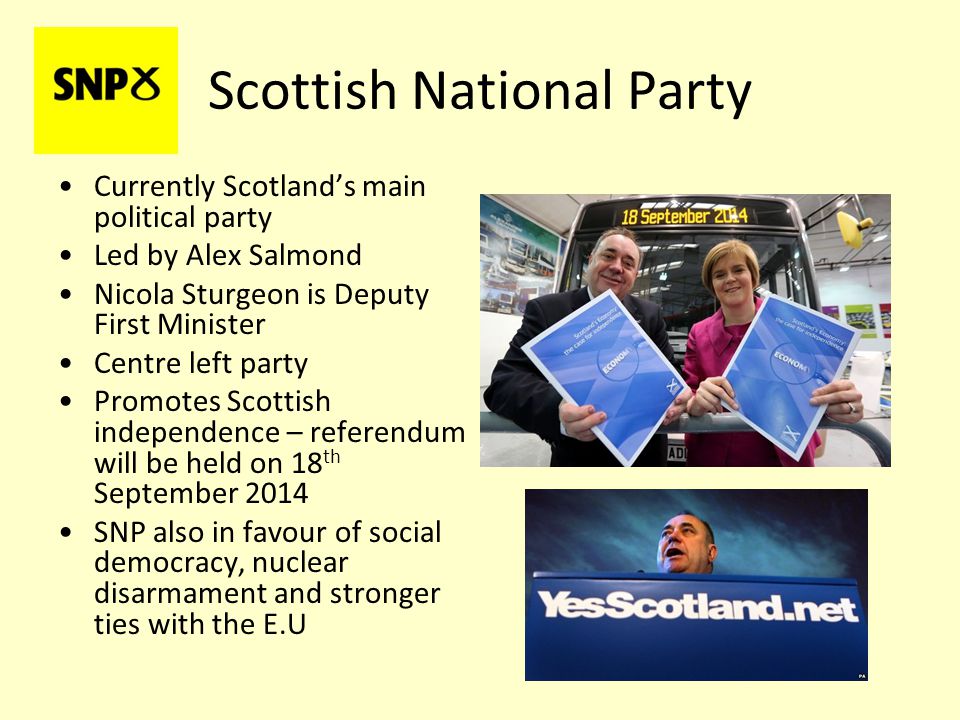
BIOGRAPHY OF
NICOLA STURGEON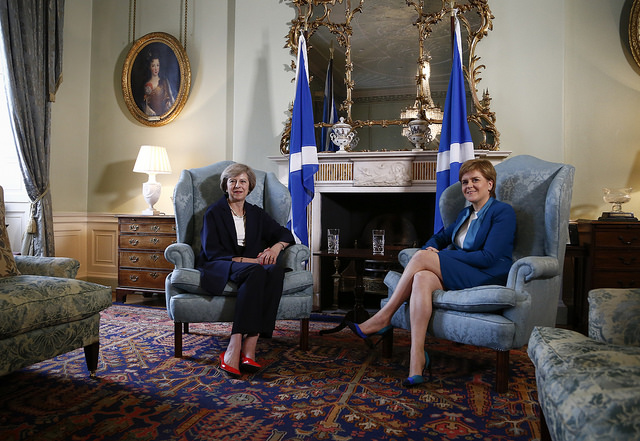 STURGEON WITH MADAM THERESA MAY OF THE U.K .AT THE BUTE HOUSE IN GLAGOW,SCOTLAND
Nicola Ferguson
Sturgeon (born 19 July
1970) is a Scottish politician serving as the fifth and current First Minister of Scotland and leader of
the Scottish National Party (SNP) since
November 2014. She is the first woman to hold either position. Sturgeon has
been a member of the Scottish Parliament since 1999, first as an additional member for the Glasgow electoral region
from 1999 to 2007 and as the member for Glasgow Southside
since 2007 (known as Glasgow Govan from
2007 to 2011).
A law graduate
of the University of Glasgow, Sturgeon worked as a solicitor in
Glasgow.
After being elected to the Scottish Parliament, she served successively as the
SNP's shadow minister for education, health, and justice. In 2004 she announced
that she would stand as a candidate for the leadership of the SNP following the
resignation of John Swinney. However, she later withdrew from the
contest in favour of Alex Salmond, standing instead as depute
(deputy) leader on a joint ticket with Salmond.
Both were
subsequently elected, and as Salmond was still an MP in the House of Commons,
Sturgeon led the SNP in the Scottish Parliament from 2004 to 2007. The SNP won
the highest number of seats in the Scottish Parliament in the 2007 election and
Salmond was subsequently appointed First Minister. He appointed Sturgeon as Deputy First Minister and Cabinet Secretary for Health
and Wellbeing. She was appointed as Cabinet
Secretary for Infrastructure, Investment and Cities in 2012.
Following the
defeat of the "Yes" campaign in the 2014 Scottish independence
referendum, Salmond announced that he would be resigning as party leader at
the SNP party conference that November, and would resign as First Minister
after a new leader was chosen.[1]
No one else was nominated for the post by the time nominations closed, leaving
Sturgeon to take the party leadership
unopposed at the SNP's annual conference. She was formally elected to
succeed Salmond as First Minister on 19 November.[2]
Early life and education
Nicola Ferguson
Sturgeon[3]
was born in Ayrshire Central Hospital in Irvine, on 19 July 1970. She is the eldest
of three daughters born to Robin Sturgeon (born 1948), an electrician, and Joan
Kerr Sturgeon (née Ferguson, born 1952), a dental nurse.[4]
Her family has some roots in North East England; her paternal grandmother was
from Ryhope in
what is now the City of Sunderland.[5]
Sturgeon grew
up in Prestwick
and Dreghorn.
She attended Dreghorn Primary School from 1975 to 1982 and Greenwood Academy from 1982 to 1988.
She later studied at the University of Glasgow, where she studied Law. Sturgeon graduated
with a Bachelor of Laws (Hons) in 1992 and a Diploma in Legal Practice the following
year.[6]
During her time at Glasgow University she was active as a member of the Glasgow University
Scottish Nationalist Association and the students' representative council.
Following her
graduation, Sturgeon completed her legal traineeship at McClure Naismith, a
Glasgow firm of solicitors, in 1995. After qualifying as a solicitor,
she worked for Bell & Craig, a firm of solicitors in Stirling, and
later at the Drumchapel Law Centre
in Glasgow
from 1997 until her election to the Scottish Parliament in 1999.[7]
Early political career
In an interview
with BBC's
Women's Hour, Sturgeon revealed that it was Margaret
Thatcher that inspired her to enter politics, because, due to rising
unemployment in Scotland at the time, she developed "a strong feeling that
it was wrong for Scotland to be governed by a Tory government that we hadn't
elected".[8]
Sturgeon joined
the Scottish National Party (SNP) in 1986,
having already become a member of the Campaign for Nuclear Disarmament,
and quickly became their Youth Affairs Vice Convener and Publicity Vice
Convener.[9][10]
She first stood for election in the 1992 general election as the
SNP candidate in the Glasgow Shettleston
constituency, and was the youngest parliamentary candidate in Scotland, failing
to win the seat.
Sturgeon also
stood unsuccessfully as the SNP candidate for the Irvine North ward on Cunninghame
District Council in May 1992, for the Baillieston/Mount Vernon ward on Strathclyde
Regional Council in 1994, and for the Bridgeton ward on Glasgow City Council in 1995.[citation needed]
In the
mid-1990s, Sturgeon and Charles Kennedy went together on a political study
visit to Australia.[11][12]
The 1997 general election saw
Sturgeon selected to fight the Glasgow Govan seat for
the SNP. Boundary changes meant that the notional Labour
majority in the seat had increased substantially. However, infighting between
the two rival candidates for the Labour nomination, Mohammed Sarwar and Mike Watson, along with an
energetic local campaign,[citation needed] resulted in
Glasgow Govan being the only Scottish seat to see a swing away from Labour in
the midst of a Labour landslide nationwide. Sarwar did, however, win
the seat with a majority of 2,914 votes.[13]
Shortly after this, Sturgeon was appointed as the SNP's spokesperson for energy
and education matters.
Sturgeon stood
for election to the Scottish Parliament in the first Scottish Parliament
election in 1999 as the SNP candidate for Glasgow Govan.[14]
Although she failed to win the seat, she was placed first in the SNP's regional
list for the Glasgow region, and
was thus elected as a Member of the Scottish Parliament.
During the first term of the Scottish Parliament, Sturgeon served as a member
of the Shadow Cabinets of both Alex
Salmond and John Swinney. She was Shadow Minister
for Children and Education from 1999 to 2000, Shadow Minister for Health
and Community Care from 2000 to 2003, and Shadow Minister for Justice from 2003
to 2004. She also served as a member of the Education, Culture and Sport
Committee and the Health and Community Care Committee.[citation needed]
Depute Leader and Deputy First Minister
On 22 June
2004, John Swinney resigned as Leader of the SNP following poor results in the European Parliament
election. His then-depute, Roseanna Cunningham, immediately announced her
intention to stand for the leadership. The previous leader, Alex Salmond,
announced at the time that he would not stand.[15]
On 24 June 2004, Sturgeon announced that she would also be a candidate in the
forthcoming election for the leadership, with Kenny
MacAskill as her running mate.[16]
However,
Salmond later announced that he did intend to stand for the leadership;
Sturgeon subsequently withdrew from the contest and declared her support for
Salmond, standing instead as his running mate for the depute leadership. It was
reported that Salmond had privately supported Sturgeon in her leadership bid,
but decided to run for the position himself as it became apparent she was
unlikely to beat Cunningham.[17]
The majority of the SNP hierarchy lent their support to the Salmond-Sturgeon
bid for the leadership, although MSP Alex Neil backed Salmond as leader, but
refused to endorse Sturgeon as depute.[18]
The results of
the leadership contest were announced on 3 September 2004, with Salmond and
Sturgeon elected as Leader and Depute Leader respectively.[19]
As Salmond was still an MP in the House of Commons, Sturgeon led the SNP at
the Scottish Parliament until the 2007 election, when Salmond was
elected as an MSP.[20]
As leader of
the SNP in the Scottish Parliament, Sturgeon became a high-profile figure in
Scottish politics and often clashed with First Minister Jack
McConnell at First Minister's Questions.
This included rows over the House of Commons' decision to replace the
Trident nuclear weapon system, and the SNP's plans to replace council
tax in Scotland with a local
income tax.[21]
Sturgeon defeated Gordon Jackson with a 4.7% swing to the
SNP in the 2007 election in Glasgow Govan.
The election resulted in a hung parliament, with the SNP the largest party by a
single seat; the SNP subsequently formed a minority government. Sturgeon was
appointed as the Deputy First Minister and Cabinet Secretary for Health
and Wellbeing by First Minister Salmond. In the position
she saw through party pledges such as scrapping prescription charges and
reversing accident and emergency closures, she also
became more widely known internationally for her handling of the 2009
flu pandemic.[22][23]
She was supported in her role as Cabinet Secretary for Health and Wellbeing by Shona
Robison MSP, the Minister for Public Health and
Sport, and by Alex Neil MSP, the Minister for Housing and
Communities.
At the 2011 election, the SNP won a
large overall majority. Sturgeon was retained as Deputy First Minister and
Cabinet Secretary for Health and Wellbeing until a reshuffle one year later,
when she was appointed as Cabinet
Secretary for Infrastructure, Investment and Cities and an additional role
overseeing the referendum on Scottish independence, essentially putting
her in charge of the SNP's referendum campaign.[24]
In December 2012, Sturgeon said that she believed that independence would allow
Scotland to build a stronger and more competitive country, and would change
spending priorities to address "the scandal of soaring poverty in a
country as rich as Scotland".[25]
On 19 September 2014, independence
was rejected in the Scottish independence referendum, with 55.3% of the voters
voting no and 44.7% voting yes.[26]
Following the defeat of the Yes Scotland campaign, Salmond announced his
resignation as First Minister and Leader of the SNP. Sturgeon immediately
announced that she would be a candidate in the election to replace him, and
received huge support from the SNP hierarchy.[27][28][29]
Sturgeon said that there would be "no greater privilege" than to lead
the SNP. On Salmond's resignation, Sturgeon said:
The personal debt of gratitude I owe
Alex is immeasurable. He has been my friend, mentor and colleague for more than
20 years. Quite simply, I would not have been able to do what I have in
politics without his constant advice, guidance and support through all these
years. [...] I can think of no greater privilege than to seek to lead the party
I joined when I was just 16. However, that decision is not for today.
Following the referendum defeat,
Sturgeon said that "further devolution is the route to independence".[30]
She also opined that Scottish independence was a matter of "when, not
if".[31]
Leadership
of the Scottish National Party
On 24 September 2014, Sturgeon
officially launched her campaign bid to succeed Salmond as Leader of the
Scottish National Party at the November leadership
election.[32][33]
It quickly became apparent that no other candidate would be able to receive
enough required nominations to run a credible leadership campaign.[34]
During the speech launching her campaign, Sturgeon announced that she would
resign as Depute Leader, triggering a concurrent depute leadership
election; the MSPs Angela Constance and Keith Brown and the MP Stewart
Hosie all nominated themselves to succeed Sturgeon as Depute Leader.[35][36]
Nominations for the SNP leadership
closed on 15 October, with Sturgeon confirmed as the only candidate.[37]
On this date, Sturgeon also came out on top in a trust rating opinion poll,
conducted for the SNP, which indicated that 54% of the Scottish population
trusted her to "stand up for Scotland's interests".[38]
Sturgeon was formally acclaimed as
the first female Leader of the SNP on 14 November 2014 at the Autumn Conference
in Perth, with Hosie as her depute. This also
effectively made her First Minister in waiting, given the SNP's absolute
majority in the Scottish Parliament.[39]
In her first speech as leader, Sturgeon said that it was "the privilege of
her life" to lead the party she joined as a teenager.[40]
First
Minister of Scotland
First
term, 2014–2016
On 19 November 2014, Salmond
formally resigned as First Minister of Scotland and the
election for the new First Minister took place the following day. Sturgeon and Ruth
Davidson, the leader of the Scottish Conservatives, stood for
election. Sturgeon received 66 votes, Davidson received 15 and there were 39
abstentions. As mentioned above, the SNP's absolute majority made Sturgeon's
election all but certain.[41]
Sturgeon was formally sworn into office the following day.[42]
On 20 November 2014, she was appointed to the Privy Council of the United Kingdom
and therefore granted the style 'The Right Honourable'.[43]
On 21 November, she unveiled her Cabinet
with a 50/50 gender balance, promoting Finance
Secretary John Swinney to become her Deputy First Minister.[44]
UK
2015 general election
Sturgeon took part in several
Scottish and UK-wide TV election debates
in the run up to the 2015 general election and
according to opinion polls was regarded to have had a successful performance.[45]
The SNP went on to win a landslide
victory in Scotland, with 56 out of 59 seats.[46]
On 4 April 2015, a leaked memo from
the Scotland Office alleged that Sturgeon privately
told the French ambassador Sylvie
Bermann that she would "rather see David Cameron remain as PM".
This was in contrast to her publicly stated opposition to a Conservative
Government on the run up to the election.[47]
The memo was quickly denied by both Sturgeon and the French consulate.[48][49]
It was later noted that the memo had contained a disclaimer that parts of the
conversation may have been "lost in translation" and its release had
been ordered by then Scottish Secretary Alistair Carmichael.[50][51]
Sturgeon stated that Carmichael had "engaged in dirty tricks" and
that he should consider his position as an MP.[52]
Scottish
Parliament election, 2016
Sturgeon contested her first
election as SNP leader at the 2016 election. The SNP fell two
seats short of securing another overall majority, but remained the largest
party in the chamber, with more than double the seats of the next-largest
party, the Scottish Conservatives.[53][54]
Sturgeon was formally nominated for
a second term on 17 May, defeating Lib Dem leader Willie
Rennie by a vote of 63 to 5, with 59 members abstaining.[55]
Second
term, 2016–present
2016
EU membership referendum
Sturgeon meets diplomats from 27 European
Union countries at Bute House to discuss the future of EU nationals
resident in Scotland following the EU referendum result
The UK Government held a referendum
to decide the future of the United Kingdom's European Union membership in which
all 32 council areas in Scotland voted by a majority for the United Kingdom to
remain a member of the EU. Across Scotland, 62% of voters backed the UK
remaining a member of the EU, with 38% voting for the UK to leave. Overall 52%
of voters in the United Kingdom voted to leave the EU, with 48% voting to
remain.[56]
In response to the result, on 24
June 2016, Sturgeon said that Scottish Government officials would begin
planning for a second independence referendum.[57][58]
Sturgeon claimed that it was "clear that the people of Scotland see their
future as part of the European Union" and that Scotland had "spoken
decisively" with a "strong, unequivocal" vote to remain in the
European Union.[59]
Sturgeon said it was "democratically unacceptable" that Scotland
could be taken out of the EU "against its will".[60]
On 24 June, Sturgeon said she would
communicate to all EU member states that Scotland had voted to stay in the EU.[61]
An emergency Scottish cabinet meeting on 25 June agreed that the Scottish
Government would seek to enter negotiations with the EU and its member states,
to explore options to protect Scotland's place in the EU."[62][63]
Sturgeon later said that while she believed in Scottish independence, her
starting point in these discussions was to protect Scotland's relationship with
the EU.[64]
May's comments confirmed that the PM wanted the Scottish government to be
"fully engaged" in the process.
Future
referendum on independence
Sturgeon confirmed in June 2016 that
the Scottish government had formally agreed to draft legislation to allow a
second independence referendum to take place.[65]
As the constitution is a reserved matter under the Scotland
Act 1998, for a future referendum on Scottish independence to be legal
under UK law, it would need to receive the consent of the British Parliament to
take place.[66]
Prior to the day the Prime Minister
triggered Article
50, formally allowing the process of the United Kingdom leaving the European
Union, the Scottish Parliament voted 69 to 59 in favour of
another independence referendum.[67]
By the end of that week, on 30 March 2017, Sturgeon wrote to the Prime Minister
requesting a Section 30 order, formally devolving the responsibility and power
to the Scottish Government to plan for and hold
another referendum on Scottish Independence.[68]
Previously, May and David Mundell, Secretary of State for Scotland,
have both highlighted that as the negotiations begin with the European Union on
the United Kingdom's withdraw, it is important for Scotland to work with the UK
Government to get the best exit deal for both the United Kingdom and Scotland,
stating that "now is not the time for another referendum".[69]
Following the 2017 UK general election,
Nicola Sturgeon announced that the Scottish Government would postpone
legislation pertaining to the proposed second referendum on Scottish
independence until at least autumn 2018, when it is believed that the outcome
of Brexit negotiations should become clearer.[70]
European
Union membership
In response to the UK-wide vote for
the United Kingdom to leave the European
Union, the Scottish Government, headed by Sturgeon,
launched the Scotland's Place in Europe document, a white paper setting
out the Scottish Government's aims and wishes of Scotland's role in Europe
post-Brexit. The paper was sent to the central British Government to be read by Prime Minister Theresa
May.
In June 2017, Sturgeon criticised
the approaches taken by both Theresa May and the British Government towards the
Brexit approach, claiming that May "will struggle" as she is a
"difficult person to build a rapport with". In the same interview,
Sturgeon committed to no independence referendum being held prior to the terms
of a UK wide Brexit deal being agreed and presented.[71]
With a view towards Brexit, Sturgeon
demanded greater powers for the Scottish Parliament, arguing that Brexit is
threatening Scotland's devolution settlement.[72]
With London seeking to restrict immigration to the United Kingdom, she asserted
that Scotland should be able to set its own immigration policy, as well as
policies relating to employment and trade.[72]
Sturgeon and the SNP went into the
Scottish council elections that were held on 4 May 2017, as the largest
political party in the 32 local council areas in Scotland, having 424
councillors elected to serve on the councils across Scotland.[73]
Publicly speaking about the 2017 Scottish council elections, Sturgeon has said
that the elections were a clear choice between voting for herself and Ruth
Davidson, the leader of the Scottish Conservative and
Unionist Party, citing the stark fall in support of the Scottish Labour Party and their leader Kezia
Dugdale over the past several years.[74]
While failing to win any outright
overall control in any council area in Scotland, the SNP emerged as the largest
political group in sixteen councils, including Glasgow, Edinburgh and Aberdeen for the first time. However, on a
notional basis, the SNP suffered a net loss of 7 councillors compared to 2012.
The party also lost its majorities in Angus
and Dundee to
no overall control.[75]
Following the results, Sturgeon claimed that the election was a "clear and
emphatic victory for the SNP', despite the large number of seats gained by the
Scottish Conservatives.[76]
In January 2019, Sturgeon referred
herself to an independent ministerial ethics body, which will lead to an
investigation into her actions with respect to a sexual harassment case concerning allegations against
Salmond. This followed her admitting that she had a secret meeting and
subsequent phone call with Salmond about the Scottish government's allegations
against him. She raised these with the Permanent Secretary to the Scottish Government, Leslie
Evans, two months later, rather than reporting them immediately, as she
should if they constitute government matters (as per the ministerial code).
Sturgeon argued that the meetings were SNP party matters, and thus not covered.
The investigating panel will consist of Dame Elish
Angiolini, a former lord advocate, and James Hamilton, a
former director of public prosecutions in
the Republic of Ireland.[77]
On 15 January 2019 the Scottish Parliament agreed to hold its own inquiry into
the matter.[78]
International
relations
While foreign policy remains a
reserved matter,[79]
Sturgeon has undertaken a number of visits to Europe, North America and Asia to
promote Scotland as a place of investment and Scottish businesses to trade and
do business with.[80][81][82]
Sturgeon has committed to strengthening links between Scotland and the African continent.[83]
In response to the Brexit vote, to
discuss Scotland's interests, Sturgeon travelled to Brussels to
meet with both Jean-Claude Juncker, the President of the European
Commission as well as Martin Schulz, the President of the European
Parliament.[84][third-party source needed]
United
States
Sturgeon was highly critical of Donald
Trump during the United States presidential
election, 2016 and had publicly backed his Democratic rival Hillary
Clinton.[85]
Sturgeon had been highly critical of Donald Trump and his policies,
highlighting her disapproval of his language and views relating to sexism and
misogyny, and stating upon Trump's victory that she hopes "Trump turns out
to be a president different to the one he was during his campaign and reaches
out to those who felt vilified by his campaign".[86]
Upon Trump's victory during the Presidential election, Sturgeon and Trump spoke
on the phone to discuss the future relationship and diplomatic approaches
between both the United States and Scotland with Sturgeon offering her well
wishes to Trump following his success. Sturgeon highlighted that "Scotland
and the United States will continue to cooperate in those areas where we share
common interests and goals, and when appropriate we will also look to have
constructive dialogue on issues where our views differ".[87]
Sturgeon had also previously
stripped Donald Trump of his ambassadorial role for Scottish businesses with
the Scottish Government in the aftermath of Trump's views of an outright ban of
Muslims from
entering the United States. Sturgeon claimed following comments made by Trump
in relation to Muslims entering the United States that he was "not
fit" for the ambassadorial role with the Scottish Government.[87]
Spain
In the run up to the Catalan independence referendum,
2017, Nicola Sturgeon offered her own personal backing and that of the Scottish Government to Catalonia in
the holding of a referendum.[88]
The Government of Spain criticised Sturgeon, claiming she had "totally
misunderstood" the situation in Spain and Catalonia.[88]
Sturgeon has highlighted that Spain should follow "the shining
example" that was created as part of the Edinburgh Agreement between the Scottish
and British Governments that allowed Scotland to hold a legally binding
referendum.[89]
Political
views
Sturgeon has campaigned against
replacing the Trident nuclear weapons system.[90]
She has been a critic of austerity, saying that the UK government's
"austerity economics" is "morally unjustifiable and economically
unsustainable".[91]
Sturgeon has also campaigned on women's
rights and gender equality, and is a self-described feminist; she
has argued that Scotland's feminist movement is not simply symbolic, but
"sends a powerful signal about equality".[92]
She has hailed Scottish feminist economist Ailsa
McKay as one of her inspirations.[93]
Awards
and acknowledgements
Sturgeon won the Scottish Politician of the Year
Award in 2008, 2012 and 2014. In 2004, 2008 and 2011 she also won the Donald
Dewar Debater of the Year Award at the same event, which is organized
by The Herald newspaper.[citation needed]
Forbes magazine ranked Sturgeon as the 50th most powerful woman in
the world in 2016 and 2nd in the United Kingdom.[94][95]
In 2015, BBC
Radio 4's Woman's Hour assessed Sturgeon to be the most
powerful and influential woman in the United Kingdom.[96]
Personal
life
Sturgeon lives in Glasgow with her
husband, Peter Murrell, who is the current chief executive of the SNP.[97]
The couple have been in a relationship since 2003. They announced their
engagement on 29 January 2010,[98]
and were married on 16 July 2010 at Òran Mór in Glasgow.[99]
Her mother Joan was the SNP Provost of North
Ayrshire council, where she was councillor for the Irvine East ward since
2007 until 2016.[100]
Sturgeon does not have children. In 2016 she disclosed that she had a
miscarriage in 2011.