Monday, 4 November 2019

UN INSISTS ON EDUCATION AND INCLUSION AS HUMAN RIGHTS

Education and inclusion should be human rights priorities, UN Assembly hears

UNAMA/Ebrahim Papal
Children attending Nuristan Primary School in Afghanistan. (File)
    
1 November 2019
UN Member States agreed seven decades ago to a set of inalienable rights to ensure the dignity of everyone. On Friday, the newly-installed General Assembly President recalled their collective responsibility through the Human Rights Council to “actualize that shared vision for a better world.”
Based in Geneva, the Human Rights Council is a 47-member UN body tasked with promoting and protecting human rights globally, with countries elected to serve by the Assembly in New York.
“Let us not forget: a just world is a safe world”, Assembly President Tijjani Muhammad-Bande stressed before the Council’s annual report was formally delivered, adding that “we can only ensure peace and development if human rights are upheld”.
Noting that the 2030 Agenda for Sustainable Development is built upon “a foundation of human rights”, he pointed out that since its adoption, the Council has mandated the Office of the High Commissioner for Human Rights (OHCHR) to convene dialogues on the Sustainable Development Goals (SDGs).
Encouraging everyone to view the SDG’s “through a human rights lens”, he drew attention to education, one of his key priorities, linking SDG 4 to articles in the Convention on the Rights of the Child, the International Covenant on Economic, Social, and Cultural Rights, and the seminal Universal Declaration of Human Rights.
Yet, Mr. Muhammad-Bande noted that “despite being anchored in these texts”, there is much to do to reach the SDG 4 targets on quality education and lifelong learning and urged for “a rights-based approach towards implementation”.
Prioritizing inclusion
To achieve all 17 Goals, he maintained, “we must ensure that all stakeholders are included…so that we leave no one behind” and made “inclusion a priority for the session”.
Citing the displaced, people with disabilities and indigenous persons, among others, he spelled out: “We will not have a UN that excludes”.
“In 2019, this is simply a no-brainer: the rights of women, everywhere, must be upheld”, he underscored.
Recalling that 20 November will mark the 30th anniversary of the Convention on the Rights of the Child, he stated, “the notion that ‘children are people, too’, serves as a reminder to us all that the rights of children everywhere must be upheld so that children do not just survive, but also to thrive”. 
“The Report of the Human Rights Council aligns not only with the aforementioned priorities of education and inclusion, but to all of the priorities I have set for the seventy-fourth session, including: peace and security through conflict prevention; poverty eradication and zero hunger; and climate action” the PGA flagged.
He said that most of the violent conflicts today have “had their origins in violations of, or disregard for, human rights”, pressing that it is “incumbent upon each Member State…to uphold equal dignity and human rights for everyone, everywhere”.
“There is no alternative to protecting the rights of the people we serve”, he concluded.
‘Even greater responsibility’ of members
For his part, Human Rights Council President Coly Seck presented an overview of the themes the Council had prioritized and underscored the important role of each country.
“By becoming a member of the Council, these States have an even greater responsibility to achieve their objectives in the promotion and respect of human rights”, he asserted.
He also noted the “high degree of harmonization and mutual respect” between “the two processes in Geneva and New York” and urged for continued “coordination and cooperation” for the protection of human rights.

 

♦ Receive daily updates directly in your inbox - Subscribe here to a topic.
♦ Download the UN News app for your iOS or Android devices.

NEWS TRACKER: PAST STORIES ON THIS ISSUE

Venezuela, Poland and Sudan amongst 14 new Human Rights Council members

14 new members were elected to the Human Rights Council on Thursday, following a secret ballot held in the General Assembly Hall in New York.

We are ‘burning up our future’, UN’s Bachelet tells Human Rights Council

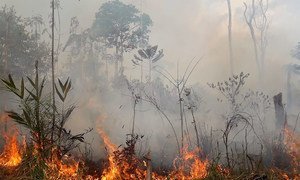
The Human Rights Council opened in Geneva on Monday with a warning from the UN’s top rights official that, with forest fires raging in the Amazon, “we are burning up our future, literally”.

UN ASKS SOUTH SUDANESE LEADERS TO FREE GOOD SAMARITANS

UN migration agency appeals to South Sudan group to free volunteer worker and child

IOM South Sudan
Flags remain at half-mast outside IOM South Sudan’s office in Juba
    
1 November 2019
The UN migration agency appealed on Friday for the immediate liberation of a volunteer and child who’ve been missing since a gun battle in South Sudan at the weekend that claimed the lives of three agency workers.
According to IOM, they were caught in the crossfire between two armed groups in Isebi, Morobo County, in South Sudan’s Central Equatoria region.
The volunteers had been manning an Ebola virus screening point in border areas between South Sudan and the Democratic Republic of Congo to prevent the spread of the deadly disease.
It is understood that the four-year-old child is the son of female IOM worker who was killed, along with two male team members.
IOM spokesperson Paul Dillon said that “all possible action” was being taken to secure the release of the two individuals immediately, and that operations had been suspended for the time being in several border areas.
“Obviously, we are there for a reason, to monitor possible flows of Ebola into South Sudan. These individuals in South Sudan as in many other countries are very much on the front line in this response... We have suspended our operations in five of those border areas until we can get clarity on the security situation and the commitment from all actors in that area that the security of our staff in that area will be safeguarded.”
IOM began operations in southern Sudan in early 2005 and established the IOM South Sudan mission after the country’s independence in July 2011.  
Last month, Deputy Special Representative and Humanitarian/Resident Coordinator Alain Noudehou noted concerns that if Ebola spread to South Sudan, it risked overwhelming the healthcare system.
Since the outbreak of civil war in December 2013, IOM has provided support to thousands of host communities, returnees and internally displaced people.
This includes those seeking protection at the United Nations Mission in South Sudan Protection of Civilians sites, IOM said in a statement. 

UNITED NATIONS!!SOCIETY PAYS HEAVY PRICE WHEN REPORTERS ARE MOLESTED

‘When journalists are targeted, societies as a whole, pay a price’: UN chief

© UNESCO
International Day to End Impunity for Crimes against Journalists.
    
1 November 2019
“Without journalists able to do their jobs in safety, we face the prospect of a world of confusion and disinformation”, UN Secretary-General António Guterres has warned in a statement released ahead of the International Day to End Impunity Against Journalists, which falls on 2 November.
“When journalists are targeted, societies as a whole pay a price”, added the UN chief. “Without the ability to protect journalists, our ability to remain informed and contribute to decision-making, is severely hampered”.

Killings and attacks on the rise

A new study from the UN Educational, Scientific and Cultural Organization, UNESCO, underscores the risks that journalists face, showing that almost 90 per cent of those found responsible for the deaths of more than 1,100 of them, between 2006 and 2018, have not been convicted.
The report, “Intensified Attacks, New Defences”, also notes that killings of journalists have risen by some 18 per cent in the past five years (2014-2018), compared to the previous five-year period.
The deadliest countries for journalists, according to the statistics, are Arab States, where almost a third of the killings took place. The Latin American and Caribbean region (26 per cent), and Asian and Pacific States (24 per cent) are the next most dangerous.
Journalists are ofen murdered for their reporting on politics, crime and corruption, and this is reflected in the study, which reveals that, in the past two years (2017-2018), more than half of journalist fatalities were in non-conflict zones.
In his statement, the Secretary-General noted the rise in the scale and number of attacks on journalists and media workers, as well as incidents that make their work much harder, including “threats of prosecution, arrest, imprisonment, denial of journalistic access and failures to investigate and prosecute crimes against them”.
A high-profile example is the murder of Maltese journalist Daphne Caruana Galizia in 2017. The case is being followed by independent UN human rights expert Agnès Callamard, among others, who has suggested that too little has been done by the Maltese authorities to investigate the killing.
On Friday, as Haiti continued to face a protracted, violent crisis that has led to the deaths of some 42 people, and 86 injured, UN human rights chief Michelle Bachelet called on all of those involved in the violence to refrain from targeting journalists, and respect the freedom of the media to do its job: at least one journalist is among those killed, and nine other reporters have been injured, according to Ms. Bachelet’s Office (OHCHR).

Keep Truth Alive

This year UNESCO has launched the #KeepTruthAlive social media campaign, which draws attention to the dangers faced by journalists close to their homes, highlighting the fact that 93% of those killed work locally, and featuring an interactive map created for the campaign, which provides a vivid demonstration of the scale and breadth of the dangers faced by journalists worldwide.
The Day is being commemorated with a flagship event in Mexico City next week on 7 November – an international seminar entitled “Strengthening regional cooperation to end impunity for crimes and attacks against journalists in Latin America” – and events are also taking place in 15 other countries, including an exhibition of press cartoons, under the headline: “Draw so as not to write them off”, at UN HQ in New York, which honours the memories of French journalists Ghislaine Dupont and Claude Verlon, murdered in Mali on 2 November 2013.


♦ Receive daily updates directly in your inbox - Subscribe here to a topic.
♦ Download the UN News app for your iOS or Android devices.

NEWS TRACKER: PAST STORIES ON THIS ISSUE

‘All actors’ must lend support as humanitarian crisis continues in Haiti, UN rights chief urges

Expressing deep concern for the impact on human rights of ongoing political unrest in Haiti, the UN rights chief on Friday called on all actors to acknowledge the grievances of Haitians, many of whom have been demanding the president step down amidst violent demonstrations which ignited a sprawling emergency in recent weeks.

Malta: Human rights experts call for justice in case of murdered journalist

Two years since the murder of anti-corruption journalist Daphne Caruana Galizia on the Mediterranean island of Malta, justice has yet to be served for the shocking crime, UN-appointed independent rights experts said on Wednesday.