Monday, 4 November 2019

CLIMATE:WHERE IS THE HOTTEST PLACE ON THE EARTH!!

paedia Weather Centre!!Where Is The Hottest Place On Earth?

Dallol, Ethiopia, is arguably the hottest inhabited place on Earth, with a daily maximum temperature of around 41 degrees Celsius. Death Valley is the hottest place overall.

SHARE

  •  
  •  
  •  
  •  
The official highest air temperature ever recorded was 134°F (56.7°C) in Death Valley, California. However, it takes more than a single isolated reading to declare a region the hottest place on the planet. The average daily highest temperature of Furnace Creek in the Death Valley is 115 degrees Fahrenheit, making it the hottest place on the planet. The ground temperature is even higher, with readings of up to 201 degrees Fahrenheit. The reasons for the extreme temperature is because the Death Valley is 150 feet below the sea level and air gets warmer with increasing depth. In addition, the valley receives less than 3 inches of rainfall annually.
The El Azizia region of Libya previously held the record for the highest air temperature recorded on the planet until September 13, 2012, when the World Meteorological Organisation (WMO) disqualified the records. The 136°F (58°C) set on September 13, 1922, was annulled after an investigation revealed that the temperature was influenced by several factors including the asphalt-like surface where it was recorded.

The Hottest Inhabited Place

The Dallol Region of northern Ethiopia is the hottest inhabited place on the planet with an average annual temperature of 95 degrees Fahrenheit (35°C). May, June, July, and August are the hottest months with temperatures averaging 100 degrees Fahrenheit. The extreme heat is attributed to the hot desert climate, lack of vegetation, and the fact that the region lies 430 feet below the sea level.

Controversies

A research team from the University of Montana studied data from the United States geological survey satellites and discovered that some of places considered the hottest in the planet should not even be contenders. Seven years of data surveyed revealed that the Lut Desert in Iran experienced the highest temperature on the planet, but the finding has not been practically confirmed at the ground level. At one point in 2005, the daily average temperature rose to a staggering 159.3 F (70.7 C). A majority of the hottest spots on the planet cannot be physically measured because they are geographically remote and climatically harsh to access and to maintain a weather station; therefore, ground-based equipment cannot be deployed. The Sahara, the Sonoran, the Lut, and Gobi Deserts are thought to be the hottest surfaces of the planet.

Trends In Global Temperature

Global warming is pushing the extreme temperatures beyond human tolerance. The sea level is rising, summers are getting extremely hot, and winters are freezing. Extreme temperatures are encroaching into human environments, and the once hot but tolerable areas are turning into uninhabitable environments. Inhabited areas such as Bandar-e Mahshahr, Iran; Ghadames, Libya; Kebili, Tunisia; Timbuktu, Mali; and Wadi Halfa, Sudan will be uninhabitable by 2050 should the current trend continue.
culled from Google

WEST PAPUA:FALSE DATA COOKED UP TO PROMOTE CORRUPTION

4 Nov 2019

Papua corruption fuelled by false population data - report

12:31 pm on 4 November 2019 
A new report alleges officials across Indonesia's West Papua have inflated population figures for personal gain.
Jayapura Harbour, Papua province, Indonesia
Jayapura Harbour, Papua province, Indonesia Photo: RNZI/Johnny Blades
The Institute for Policy Analysis of Conflict, or IPAC, is calling on the government to improve conditions ahead of next year's census.
The report, Numbers Matter: The 2020 Census and Conflict in Papua, said inflated population statistics had fuelled corruption and conflict in the region.
In the Papuan provinces, a bigger population often means more funding from the national government.
"Statistics on population, weak to begin with because of the difficulties of reaching remote areas and poor record-keeping, have grown steadily worse in the last two decades as local Papuan elites have deliberately inflated numbers as a way to gain money and power," the report said.
The Central Highlands population might be less than half of what the voter turnout there was in this year's elections, it said.
It also linked poor population data to ongoing violence in Papua, which has killed dozens this year during protests.
"The need for a new strategy for addressing conflict in Papua is critical, and a new strategy depends on better data," said IPAC director Sidney Jones.
The population in Papua's Central Highlands might be less than half of what 2019 voter roles suggest, with "elites" from the area aided by a traditional Papuan system of proxy voting which, in many areas, resulted in a 100 percent voter turnout, the report said.
"Highlanders, led by [Papua Governor] Lukas Enembe, now control all key provincial institutions, including the governorship, the provincial parliament, and the Papuan People's Council," the report noted.
In one regency, Jayawijaya, at the time of the 2017 local elections, data from one agency showed a village as having 50,000 more people than data from another agency suggested.
The report called on the Indonesian government to adequately resource departments tasked with conducting the 2020 census, including hiring additional staff in Papua and providing them with helicopters to access remote villages.
"A more accurate headcount," the report said, "could provide the basis for rethinking Papua strategy, from governance to security to fiscal accountability."

CITIZEN MEDIA TO THE RESCUE AS CREAM OF GLOBAL PRESS AVOIDS WEST PAPUA LIKE A LEPER

Moale James: Citizen journalism countering ‘deliberate’ media silence on West Papua

 
0
145
SHARE 
“Citizen journalism” coming out of West Papua has created global pressure on the Indonesian Government. Image: Free West Papua
OPINION:  By Moale James
What should we expect for the future of media freedom in the Pacific? And how do we sift through the “bullshit” as emerging journalists? These were two of the many questions raised at the pre-conference keynote for the Melanesian Media Freedom Forum at Griffith University, Brisbane.
Attending on the night where various media professionals, many with extensive careers in the Pacific. A few notable attendees included SBS correspondent Stefan Armbruster, retired foreign correspondent Sean Dorney, radio journalist Pauline Nare and academic Dr Tess Newton Cain.
Key note speaker, Professor David Robie focused the night’s conversation on the lack of media freedom in West Papua with the main issue being the lack of international media attention and its effect on opportunities to make positive humanitarian changes.
To date, 528,000 West Papuans have lost their lives to a slow-motion genocide.
Dr Robie and audience members expressed their disgust and concern at the silence and inaction from international governments and the lack of media reporting on these events.

- Partner -
With a death toll as high as this, it becomes clear that the lack of journalistic reporting on this issue is a deliberate decision. This is not a number that can simply be ignored.
Dr Robie likened the media situation in West Papua to the cases of imprisoned female investigative journalists in Iran. The deliberate action of imprisoning critical journalists who are exposing human rights abuses is a mirrored pattern in the Pacific.
However, although there are international journalists being imprisoned there is an exciting emergence of “citizen journalism” a term that describes the creation, collection and distribution of news and information by the public on the internet and social media.
West Papuans are using the resources that they have on the ground and in their hands to capture the human rights abuses they are experiencing and actively sharing these online, forcing open the eyes of the world onto the slow genocide occurring in West Papua.
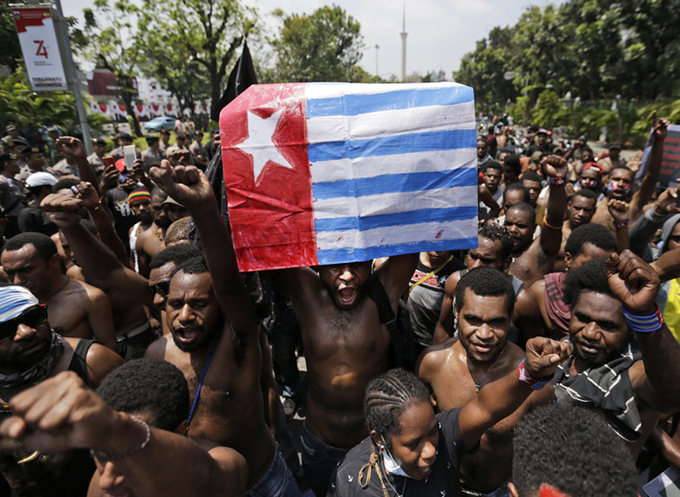
The “citizen journalism” coming out of West Papua has created global pressure on the Indonesian Government, which initiated a blackout across West Papua on August 21, 2019  in response to the growing unrest. Black spots are still active today in Jayapura and Manokwari.
Coming to the end of the keynote presentation, Dr Robie unfurled the West Papuan flag  from behind the podium. In an act of solidarity, he asked all attendants to stand with him and make the promise that they would endeavour to be honest, passionate and critical journalists when it came to writing about the atrocities in West Papua.
If mainstream media are deliberately choosing not to report on the events in West Papua, then independent journalists must make the conscious decision to do so instead.
As the lecture came to an end it became clear that conversations around West Papua did not simply end with the slideshow. Conversations and deliberate actions of those present following this event are sure to be the catalyst for change for media freedom in not only West Papua but across the Pacific.
Papua Merdeka from Sorong to Samarai.
  • Moale James is a student at the University of Queensland undertaking her Bachelor in Journalism. Moale also proudly identifies as a mixed-race Papua New Guinean-Australian.

UNITED NATIONS OUTLINES EFFECTS OF SELECTED TOXINS ON THE ENVIRONMENT

Microplastics, microbeads and single-use plastics poisoning sea life and affecting humans, says UN Environment

UNEP/Shawn Heinrichs
Trash at a beach in Bali where the UN Environment Programme launched the Clean Seas Campaign.
    
4 November 2019
Each year, an estimated eight million tonnes of plastic ends up in the ocean – equivalent to a full garbage truck every minute dumped into the sea – the United Nations Environment Programme (UNEP) said Monday, drawing attention to the damage it cause and cost-effective switches that can be made.
Between 60 to 90 per cent of the litter that accumulates on shorelines, the surface and the sea floor is made up of plastic. 
The most common items are cigarette butts, bags, and food and beverage containers. Consequently, marine litter harms over 800 marine species, 15 of which are endangered. And plastic consumed by marine species enters the human food chain through fish consumption. 
Alarmingly, in the last 20 years, the proliferation of microplastics, microbeads and single-use plastics have made this problem even more pronounced. 
Most people associate marine plastic pollution with sights of plastic litter along coastlines or floating on sea surface. But microplastics and microbeads pose a hidden challenge; they are out of sight, and therefore out of mind. 

Clean Seas Campaign

“What’s in Your Bathroom?”, the United Nations Environment Programme (UNEP) asked on Monday, as part of a campaign to raise awareness on the harm caused by plastics in personal care products and shifts that can be made to reduce plastic footprints.

Microplastics listed on cosmetic ingredients

  • Polyethylene (PE)
  • Polymethyl methacrylate (PMMA)
  • Nylon
  • Polyethylene terephthalate (PET) 
  • Polypropylene (PP)
UNEP launched the Clean Seas Campaign in 2017 to galvanize a global movement tackling the excessive practice of single-use plastics and microbeads. 
Now in its second phase, it is shining a light on specific aspects of marine litter, such as plastic pollution generated by the cosmetic industry.
Many consumers are not aware just how much plastic there may be in the personal care items they use daily on their faces and bodies. 
From the plastic in packaging to the under-5mm microplastics hidden within the products, including beads or glitter, they are designed to wash down the drain, travel through rivers and end up in the sea.
Microplastics are too small to be filtered out by waste treatment plants and they attract waterborne toxins and bacteria that stick to their surfaces. Because they look like food, they are eaten by fish, amphibians, insect, larvae and marine animals as well as seabirds and other marine life, blocking digestive tracts and causing physical problems. 
In addition to endangering marine life, the health implications of microplastics on humans are not yet fully known, but considering their prevalence in clothes, food, water and cosmetics, are expected to be far reaching.
For the next week, UNEP invites everyone to examine products in their bathrooms and  check its Instagram for information on how they can join the campaign. 


♦ Receive daily updates directly in your inbox - Subscribe here to a topic.
♦ Download the UN News app for your iOS or Android devices.

NEWS TRACKER: PAST STORIES ON THIS ISSUE

Assembly President launches new initiative to purge plastics and purify oceans

The President of the UN General Assembly launched a new global call to action on Tuesday, to help end the scourge of plastic pollution in the ocean.