Friday, 17 January 2020

THE UNITED NATIONS PROTECTING THE DISPLACED IN BANGUI

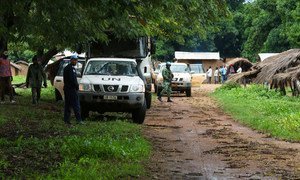
UN peacekeepers protecting hundreds displaced by Central African Republic fighting

OCHA/Karen Perrin
After armed clashes, a child walks among the charred ruins of Alindao, a city in the Central African Republic.
    
15 January 2020
Fresh clashes in the Central African Republic’s southeast have driven some 400 people to seek shelter at a UN base there, the United Nations Spokesperson said on Wednesday.
Peacekeepers are patrolling the city of Alindao, Basse Kotto Prefecture, after skirmishes last Thursday between the country’s armed forces and members of an armed group associated with the mainly-Muslim ex-Seleka coalition, which have fought with mainly Christian anti-Balaka elements, destabilizing the nation since 2013.
“Two personnel from the Central African Republic’s (CAR) armed forces died in the violence”, Stéphane Dujarric told reporters in New York. “Today, the UN Mission says that the situation is calm, despite continuing tensions”. 
On 9 January, 650 families temporarily sought refuge in a hospital while at least nine people were injured by stray bullets and dozens of houses burned at the ELIM displacement site, according to the UN humanitarian affairs coordination office (OCHA). 
According to OCHA’s initial assessment, some 2,000 internally displaced people (IDPs) urgently need food, shelter and non-food items. Humanitarians are urgently mobilizing resources to meet their needs.
Mr. Dujarric said that the UN Stabilization Mission in CAR, which goes by the French acronym, MINUSCA, is preparing to send an investigation team of police, human rights and prison officers to Alindao.

Securing the capital

Meanwhile, Mr. Dujarric reported an update on efforts to secure the capital of Bangui’s PK5 Muslim enclave, which, on 31 December, was declared an "unarmed area", or weapons-free zone.
“The Mission says that all 13 bases of the ex-self-defense groups have now been dismantled”, he said, adding that “UN peacekeepers continue to conduct joint patrols with the Central African Republic’s Internal Security Forces to protect civilians”. 
The Mission has also launched an awareness campaign in the PK5 neighborhood to explain its outreach work to the community and protect civilians.


♦ Receive daily updates directly in your inbox - Subscribe here to a topic.
♦ Download the UN News app for your iOS or Android devices.

NEWS TRACKER: PAST STORIES ON THIS ISSUE

Central African Republic: ‘Transform dreams of peace into reality’: mission chief tells Security Council

Updating the Security Council on the situation in the Central African Republic (CAR) on Friday, the head of the UN Mission in the country, MINUSCA, called on the country’s friends and partners, including the Council, to “transform the dreams of peace, prosperity and development of millions of Central Africans into a lasting reality”.

Central Africans ‘need our help now’: UN’s deputy relief chief 

“Spikes of violence” in previously unaffected areas of the Central African Republic (CAR) have prompted new displacement, the United Nations Deputy Emergency Relief Coordinator said on Wednesday, calling for additional funding to meet the humanitarian needs of 2.9 million people.

FROM THE PAEDIA WEATHER CENTRE IN LAGOS,NIGERIA!!U.N SAYS 2019 2ND HOTTEST YEAR EVER ON RECORD


2019 second hottest year on record, UN confirms

WMO/Jordi Anon
2019 was the second warmest year on record after 2016, according to the World Meteorological Organization.
    
15 January 2020
Last year was the second warmest year on record, the World Meteorological Organization (WMO) confirmed on Wednesday. 
“The average global temperature has risen by about 1.1°C since the pre-industrial era and ocean heat content is at a record level,” said WMO Secretary-General Petteri Taalas.  
“On the current path of carbon dioxide emissions, we are heading towards a temperature increase of 3 to 5 degrees Celsius by the end of century.” 
WMO analysis showed the annual global temperature in 2019 was 1.1°C warmer than in the period from 1850-1900, or the pre-industrial era. 
Only 2016 was hotter, due to a very strong El Niño which causes warming, combined with long-term climate change. 
Furthermore, average temperatures for the past five years and 10 years, respectively, were the highest on record. 
Since the 1980s, each decade has been warmer than the previous one: a trend the UN agency expects will continue due to the record level of greenhouse gases in the atmosphere.  
WMO added that 2019 and the past decade also were characterized by retreating ice, record sea levels, increasing ocean heat and acidification, and extreme weather, all of which have “major impacts” on human health and the natural environment. 
Meanwhile, the New Year began where 2019 left off, according to Mr. Taalas. 
“Australia had its hottest, driest year on record in 2019, setting the scene for the massive bushfires which were so devastating to people and property, wildlife, ecosystems and the environment,” he said. 
“Unfortunately, we expect to see much extreme weather throughout 2020 and the coming decades, fuelled by record levels of heat-trapping greenhouse gases in the atmosphere.”   

RECENT GLOBAL SITUATIONS FROM THE UNITED NATIONS DESK IN THE LAST ONE WEEK

Implementing peace deal only path for stabilization in Mali: UN peacekeeping chief

MINUSMA/Harandane Dicko
UN peacekeepers return to their helicopter following a mission to the village of Sobane Da in the Mopti region of Mali.
    
15 January 2020
Implementation of the 2015 peace agreement in Mali provides the only pathway for stabilization there, the head of UN peacekeeping told the Security Council on Wednesday. 
Jean-Pierre Lacroix updated ambassadors on developments in the West African country, where a UN operation, known by the French acronym MINUSMA, supports political processes and restoration of state authority against a backdrop of insecurity, intercommunal violence and increasing displacement. 
MINUSMA was established following fighting between Government forces and Tuareg rebels in January 2012, leading to the occupation of northern Mali by radical Islamists.   
The authorities and two separate armed group coalitions signed the peace deal three years later. 
“The rapid and thorough implementation of the peace agreement remains the only viable path for the stabilization of Mali.  It provides the framework for the required political and institutional reforms to restore and decentralize State authority, to build a Malian state that reflects the diversity and interests of all its citizens”, said Mr. Lacroix. 
“The peace agreement also provides for mechanisms to address the grievances of those Malians who feel excluded from the country’s political life and economic development and who see little hope for their future.” 

National dialogue concludes 

Despite slow starts and disagreements, both between and among the sides, the UN peacekeeping chief reported that progress has been achieved in Mali, such as the holding of an inclusive national dialogue which concluded in December. 
Foreign Minister Tiébilé Dramé characterized it as a milestone for his country.  
“The national dialogue was an important point in the life of the nation: a point at which a true national consensus was forged with lively solidarity,” he said, speaking via videoconference.  
“For his part, the President of Mali has taken the commitment of doing everything in his power to ensure that the resolutions and recommendations of the national dialogue, pursuant to current law, be implemented.”  

Regional plans 

Another step forward has been the disarming and subsequent integration of former combatants into the national defence and security forces. 
Mr. Lacroix said redeploying reconstituted army units to the north remains an “urgent priority”, with a first battalion expected in the region by the end of the month: an important step towards restoring state authority nation-wide. 
At the same time, the UN has increased its presence and activity in Mopti, located in central Mali, which has contributed to de-escalating intercommunal violence and massacres. 
However, this has meant diverting assets from the north, leading to what Mr. Lacroix described as “dangerous gaps” in some areas.  To address the challenge, MINUSMA will make some adaptations within its authorized troop strength. 
“The plan provides for the establishment of a Mobile Task Force, which will enhance the Mission’s ability to implement its mandate and protect civilians. It will make MINUSMA more agile, flexible and mobile with tailored units and enhanced capabilities, most importantly additional air mobility”, he explained, before calling on ambassadors for their support. 

Support for the Sahel  

Mr. Lacroix began his briefing by addressing the “alarming” deteriorating security situation not only in Mali but in the wider Sahel.   
Just last week alone, 89 soldiers from Niger were killed and 18 peacekeepers injured in two separate attacks. There has also been a rise in the use of improvised explosive devices (IEDs) against UN convoys. 
“Terrorism continues to feed into inter-communal violence in the centre of Mali,” he reported.  “There are now more displaced persons suffering from hunger in the Mopti region than there were in the past.” 
The United Nations supports the G5 Sahel regional body, which brings together Burkina Faso, Chad, Mali, Mauritania and Niger, all of which are experiencing rising extremist violence. 
French ambassador Nicolas de Rivière told the Council that following a recent summit held in his country, the G5 and its international partners have established a coalition for the Sahel. 
“The aim is to step up our support for countries of the G5 Sahel, but also beyond that to incentivize them to engage in reform: of course, security reform, but also governance and human rights reform,” he said. “With these conditions being met, we can eradicate terrorism.”