
Saturday, 27 April 2019

Friday, 26 April 2019
HINDUSTAN TIMES REVEALS OF FRESH ONLSLAUGHTS AGAINST SRI LANKAN EXTREMISTS
After
Sri Lanka blasts, drive on to hunt down ‘sleeper cells’
Hindustan Times, New Delhi
The IS has owned up the terror attacks in the
island nation that killed more than 250 people.

Soldiers
stand guard outside St. Anthony's Shrine in Colombo on April 25, 2019,
following a series of bomb blasts targeting churches and luxury hotels on the
Easter Sunday in Sri Lanka.(AFP file photo)
·
·
·
·
·
·
Kerala
and Tamil Nadu police, in association with central agencies, have launched an
operation in their states to look for possible “sleeper cells” and
“sympathisers” of Islamic State and National Towheed Jama’at (NTJ), the two
outfits linked to Easter Sunday bombings in Sri Lanka, a counter-terrorism
official familiar with the developments said.
The
IS has owned up the terror attacks in the island nation that killed more than
250 people. One of the attackers was identified as NTJ leader Maulvi Zahran Bin
Hashim, who blew himself up at Shangri La hotel in Colombo on Sunday.
The
operation has been launched in the two southern states to thwart any possible
terror attacks, the official cited above added.
Investigators
have found that Sri Lanka attack mastermind Hashim, a radical preacher, was in
touch with some Tamil Nadu and Kerala-based people in a bid to create a
separate “Islamic State confederation” in the region.
Six IS members from Tamil Nadu’s Coimbatore district, who according to a
National Investigation Agency probe, were radicalised after watching Hashim’s
videos, were arrested in
September 2018.
September 2018.
Over half a dozen others from Kerala’s Palakkad,
Kozhikode and other parts of the coastal state had travelled to Sri Lanka on
different dates before finally shifting to Afghanistan’s
Nangarhar province, the official said.
Nangarhar province, the official said.
The
central agencies suspect there could be several other IS “sleeper cells” and
“followers” in these two states who might have some information about Sri Lanka
blasts, or were in touch with the attackers.
Kerala police chief Loknath Behera confirmed that the state police are
assisting the central agencies in the operation. Tamil Nadu director general of
police T K Rajendran refused to comment.
Conversations
on social media, call records and statements of IS recruits arrested from these
two states in the past are being analysed to look for clues. Majority of IS
recruits, who either travelled to Syria or Afghanistan, were from Kerala, the
official claimed.
Another
official from the ministry of home affairs, who asked not to be named, said
several rounds of meetings have also taken place between Research and Analysis
Wing , Intelligence Bureau, NIA and other agencies to discuss the strategy on
how to contain the threat.
The government has repeatedly asserted that IS has got “negligible” support
from Indian Muslims while all the state police forces have worked in
coordination for past four-five years to restrain the activities of global
terror
outfit.
outfit.
According
to a second MHA official, countries such as Canada, Japan, Singapore, and
Bangladesh have often approached Indian agencies seeking to emulate their
approach on controlling the IS.
The
Indian agencies are currently helping the Sri Lankan authorities informally in
the blasts’ probe, and if requested, an NIA team could also be sent there, said
the MHA official cited above.
MOZAMBIQUE WEATHER UPDATE
PAEDIA WEATHER CENTRE,LAGOS,NIGERIA
after Cyclone Idai another round of violent waves are expected as at press time on the 26th of April,2019 at 6:30 p.m.

after Cyclone Idai another round of violent waves are expected as at press time on the 26th of April,2019 at 6:30 p.m.
report this ad
1 - 5 of 90 days | All 90 days
25°RealFeel® 27°
Partly cloudy- Winds from the ESE
- 9 km/h
- Humidity: 78%
- Pressure: 1014.00 mb ↑
- UV Index: 0
- Cloud Cover: 35%
- Ceiling: 9144 m
- Dew Point: 21° C
- Visibility: 16 km
TEMPERATURE HISTORY
More Historical Weather Data| Today | Normal | Record | 4/26/2018 | |
|---|---|---|---|---|
| High | 31° | 30° | N/A | 34° |
| Low | 20° | 21° | N/A | 17° |
UNITED NATIONS!ROHINGYAS STILL FACE TOUGH FUTURE
Future of Rohingya refugees in Bangladesh ‘hangs in the balance’ –
UNHCR chief
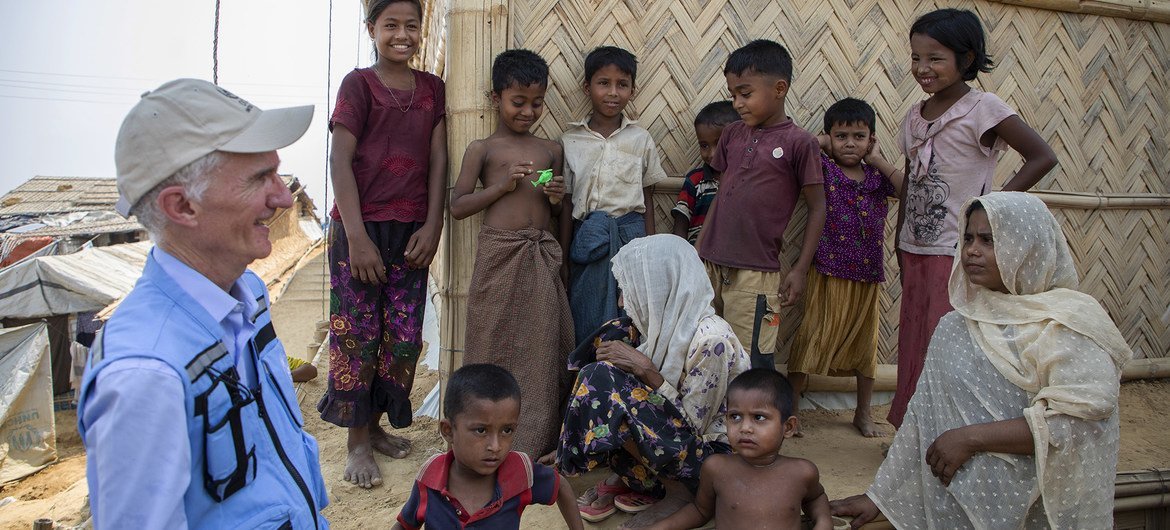
©
UNHCR/Will Swanson
Emergency Relief Coordinator, Mark Lowcock with a group of
Rohingya refugees from Myanmar in Kutapalong Refugee Camp, Bangladesh on 26
April 2019.
26 April 2019
The critical needs of 1.2 million mostly
Rohingya refugees in south-eastern Bangladesh were top of the agenda for a
fact-finding mission to the region by three senior United Nations officials,
who called for continuing support on Friday for them from the international
community.
At the end of a joint visit to
the country, UN Emergency Relief Coordinator Mark Lowcock, head of
UN migration agency (IOM) António Vitorino, and UN High
Commissioner for Refugees (UNHCR), Filippo Grandi, reiterated their commitment
to find safe and sustainable solutions for Rohingya refugees in
Bangladesh, as well as helping them to make a safe and dignified return
home.
Since August 2017, nearly 900,000 minority
Muslim Rohingyas have fled violence across the border into Bangladesh’s Cox’s
Bazar region, joining several hundred thousand others that had already settled
there in overcrowded camps.
Mr. Lowcock painted a picture of “the most
appalling brutality imaginable” during his first visit in 2017, when he “met
with children who had seen parents killed” and women who, “just holding on”,
recounted “horrendous stories of sexual violence they had survived”.
After visiting Cox’s Bazar this trip they
noted that almost half of the 540,000 refugee children under the age of 12 are
missing out completely on an education, while the remainder are only able to
access very limited schooling. Moreover, just a handful of teenagers are
currently able to access any form of education or training.
“With the current crisis almost two years on,
we must give refugees the chance to learn, build skills and contribute to their
communities while also preparing for reintegration when they can return to
Myanmar,” said Mr. Grandi. “The future of the Rohingya refugees hangs in the
balance.”
The visit came just prior to the onset of
cyclone season, which is followed by the arrival of monsoons, both posing
serious risks of flooding, landslides and disease outbreaks to thousands of
vulnerable women, men and children.
“We are concerned for the welfare of the
Rohingya refugees who live in such vulnerable circumstances in Cox’s Bazar, as
well as for host communities which also face significant challenges,
particularly in the lead up to the monsoon season,” said António Vitorino.
The UN leaders discussed with the Government
ways that the international community can further support preparedness and
response efforts.
“The Rohingya community is made up of so many
young people who are in need of hope and opportunities if they are to build
successful lives upon their return to Myanmar”, Mr. Vitorino added.
They also met families undergoing a joint
Government-UNHCR registration process, receiving documents that for many are a
first to confirm their identity in Bangladesh and enhance their rights to
access services and protection.
“This remains one of the world’s biggest
refugee crises,” maintained Mr. Grandi. “I saw a great deal of progress, but
their situation, especially for women and children, remains fragile”.
While in the camps, they assessed ongoing work
to address weather-related risks, including strengthening shelters, improving
infrastructure, and training volunteers while recognizing the critical role the
refugees themselves are playing in these efforts.
“A wise, far-sighted approach would see a
stronger focus on helping the refugees not just recover from the horrors they
have experienced, but also to prepare for a dignified longer-term future,”
concluded Mr. Lowcock.
Subscribe to:
Posts (Atom)