Thursday, 30 May 2019

UNITED EUROPE NEEDED AT THIS JUNCTURE IN WORLD HISTORY SAYS UNITED NATIONS


A ‘strong and united Europe’ has never been more needed, declares UN chief Guterres
UNFCCC/James Dowson
UN Secretary-General António Guterres receives the Charlemagne Prize in Aachen, Germany on 30 May 2019.
    
30 May 2019
With the post-world war international institutions eroded and under threat, a “strong and united Europe” standing alongside the United Nations, has never been more essential, said UN chief António Guterres in Germany on Thursday.
The Secretary-General was in the ancient continental capital of Aachen, close to the French border, where he received the Charlemagne Prize, awarded each year since 1950, for services towards European unification.
As a former Portuguese Prime Minister, and one of the architects of the European Union’s efforts in the late 1990s and early 2000s to strengthen social safety nets, solidarity, and cooperation with Africa and India, Mr. Guterres described himself as a “committed European” who understood that, in bestowing the award, Aachen was paying tribute “to the commitment, service, and sacrifice of the women and men of the United Nations”.
The European Union, which grew out of the ashes of two world wars, has forged “an exemplary partnership” with the United Nations, said Mr. Guterres, and the breakup of the 28-nation political and economic bloc, “would inevitably be the failure of multilateralism and the failure of a world in which the rule of law can prevail”.
“The hard truth is, we collectively have taken too many things for granted”, he added, noting that democratic principles “are under siege, and the rule of law is being undermined. Inequalities are on the rise. Hate speech, racism and xenophobia are fuelling terrorism through social media”.
Hailing Europe’s continuing role as a champion of universal values, he said that multilateralism was under fire “precisely when we need it most, and when it has never been so fit to address these challenges”.

‘We need to restore trust’

 “I wish Europe could stand up more decisively for the multilateral agenda. The United Nations need a strong and united Europe. For this to happen, Europe will need to come to grips with some serious challenges”, said Mr. Guterres.
Despite an apparent “lack of ownership by the peoples of Europe” of their collective future as a union, he said there were “encouraging signals” of more political engagement in last week’s elections to the European Parliament.
“This is the moment in which we need to restore trust. Trust between people and political establishments. Trust between people and the institutions. Trust between people and international organizations”, he said, noting that the young Europeans of today were “our best hope”.
With three great challenges facing us all, he said the EU “must lead the way”. First, on climate change, he said more ambition was needed all round, in mitigation, adaptation and finance.
“It is much better to tax pollution than jobs…Does it make any sense that our money, as tax payers, is used to boost hurricanes, to spread drought, to bleach corrals, to melt glaciers, to diminish biodiversity and to progressively destroy the world?”
Second, he said Europe was “particularly well placed” to take a lead in the transformation of society through new technology, with its robust regulatory framework on protecting digital privacy, and especially through the huge potential of Artificial Intelligence, or AI.
New social safety nets will be needed, he said, to cope with the Fourth Industrial Revolution that is underway: “The European social model is the best foundation to be able to respond to these challenges and Europe has an absolutely unique role to play in creating the conditions to transform these areas in a positive manner.”
UNFCCC/James Dowson
In Aachen, Germany, the UN Secretary-General António Guterres receives the Charlemagne Prize awarded for work done in the service of European unification. (30 May 2019)

Scapegoating migrants ‘shames’ Europe’s heritage

Third, the culture of the continent has always been enriched through diversity, pointing to Emperor Charlemagne himself, founder of the first experiment in European political integration more than a thousand years ago, the so-called Holy Roman Empire.
Assimilation “was the starting point of European culture”, said the UN chief. “Of course, Europe must hold true its values enshrined in the Charter of fundamental human rights and in the European Convention on Human rights. But Europe cannot be premised on ‘us versus them’”.
“Scapegoating migrants and closing our doors to asylum seekers does not protect, but shame this heritage”, he declared, noting that the 1951 Refugee Convention was adopted to protect ravaged and displaced post-war Europeans.
“It is only by being united that Europe will propose a balanced approach addressing the root causes of migration while preserving the rights and dignity of migrants,” he said.
“All societies tend to be, or are already, multi-ethnic, multi-cultural and multi-religious. This must be considered as a richness not as a threat”

UNITED NATIONS ON CHINESE ECONOMY,TOBACCO,CLIMATIC DEBATE

: #NoTobacco Day, China’s economy, family farming, #ClimateAction

UNICEF/UN0305927/Oatway
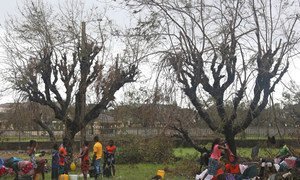
Children at a UNICEF supported school near Dondo, Mozambique where at least 1.6 million children need urgent assistance one month after Cyclone Idai devastated parts of Mozambique, Malawi and Zimbabwe.
    
29 May 2019
This Wednesday, we cover: the dangers of smoking for World No Tobacco Day; China’s creative economy; sustainability through family farming, floating cities and #ClimateAction.

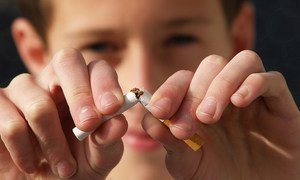
Don’t let smoking steal life’s breathtaking moments, urges UN health agency

Tobacco use continues to claim around eight million lives a year, the World Health Organization (WHO) said on Wednesday, in a call for faster action from governments to tackle smoking and the “enormous” health, social, environmental and economic costs it entails.
Ahead of World No Tobacco Day, marked on Friday, 31 May, WHO’s Dr Vinayak Prasad, acting Director, Department for the Prevention of Noncommunicable Diseases, highlighted the damage that tobacco causes to the lungs of smokers and non-smokers alike.

China’s ‘remarkable’ creative economy marches ahead 

China’s creative economy – which includes books, film, music and video games – is growing faster than other countries, making it the world’s driving force in the field over the past 15 years, says a new UN trade report. 
The study from the UN Conference on Trade and Development, UNCTAD, tracks national performance in the trade of creative goods and services between 2002 and 2015, and shows that China is the biggest single exporter and importer, with trade growing “exponentially” over the period. 
China’s performance is described in the report as “remarkable”, because of its sustained growth over three decades, its dominance of the world market for creative goods and services, and its role in sustaining the regional and global creative economy. 
Speaking to UN News, Amy-Louise Shelver from UNCTAD said the report shows that the view of China as simply “the factory of the world” is now outdated: “I think that’s a one-dimensional view of what’s actually happening in China. Obviously China’s growth over the past 20 to 30 years has certainly been based on its performance as a factory of the world: that’s what it’s used to kickstart its economy. Subsequent to that, there’s been a massive broadening of China’s goods and services offering, and it’s important to see it as a multi-dimensional economy, not simply a manufacturing hub.”

Family farms are ‘drivers of sustainable development’ 

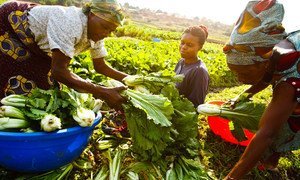
Launching the United Nations Decade of Family Farming in Rome on Wednesday, two UN agencies have lauded family-run farms, which account for over 90 per cent of the sector, as “key drivers of sustainable development,” that play a major role in ending hunger and malnutrition.  
The Food and Agriculture Organization (FAO) and the International Fund for Agricultural Development (IFAD) also announced a Global Action Plan to upgrade support for family farmers, particularly those in developing countries, with detailed guidance for the international community.  
Although farmers produce most of our food, they are vulnerable to poverty, especially in developing countries, and the plan highlights the need to increase access to social protection for farmers, as well as finance, training and opportunities to generate income. 

Mozambique cyclones a ‘wake-up call’ to boost resistance: UN weather agency

The havoc caused by cyclones Idai and Kenneth across Mozambique is “a wake-up call” for vulnerable countries “to build resistance" against further high-impact tropical storms, coastal flooding and intense rainfall linked to climate change, according to the United Nations weather agency chief.
A World Meteorological Organization (WMO) fact-finding mission to Mozambique recommended on Wednesday a package of disaster-risk-reduction priorities to strengthen the country’s early warning systems and reduce damage due to weather, climate and water-related hazards.

Floating Cities: the new urban frontier

Climate change and urbanization are combining to create an urgent global need for sustainable cities. In response, the United Nations is exploring how the creation of floating cities can help solve the urban crisis while.

Listen to or download our audio News In Brief for 29 May on SoundCloud:

UNITED NATIONS!!!SAVE TUVALU,SAVE THE WORLD FROM SINKING

‘Save Tuvalu; save the world’; UN chief echoes rallying cry from front lines of global climate emergency

UNICEF/Sokhin
A 16-year-old child swims in the flooded area of Aberao village in Kiribati. The Pacific island is one of the countries worst affected by sea-level rise.
    
29 May 2019
Further inaction on climate change is “simply not an option”, United Nations Secretary-General António Guterres said on Wednesday in an opinion piece where he called for “rapid and deep change in how we do business, generate power, build cities and feed the world.” 
 
If the world is to prevail against climate change, “then we must find the political will to take transformative measures,” declared the UN chief. 
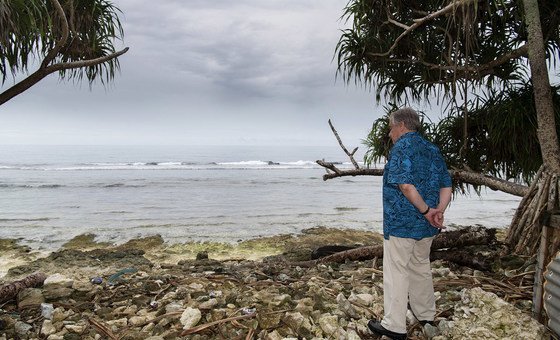
UN Photo/Mark Garten | Secretary-General António Guterres on the Pacific Ocean island of Tuvalu. (17 May 2019)
“Leaders must come to the UN summit in September armed with solutions as well as speeches”, he stressed, referring to the action-focused meeting he is convening in September to mobilize political ambition on climate change and push forward the goals of the Paris Agreement, which encompass greenhouse-gas-emissions mitigation, adaptation, and finance. 
On his recent Pacific tour to the frontlines of the global climate emergency, he heard the rallying cry “Save Tuvalu; save the world,” while visiting the tiny island archipelago that is battling sea level rise and coastal erosion as warming temperatures threaten the region.               
“I was there to show solidarity with those suffering the worst impacts of climate change and to draw attention to the innovative climate action underway in the region,” explained the UN chief. 
Sea level rise in some Pacific countries is “four times greater than the global average”, he stated, saying that it poses “an existential threat to several island States”.  
“Oceans are in serious trouble, from coral bleaching to biodiversity loss to plastic pollution”, he warned. “Extreme weather events are on the rise, jeopardizing lives and livelihoods”. 
Mr. Guterres spelled out: “Nowhere have I seen the heartbreaking impacts of climate change more starkly than in Tuvalu, a remote coral atoll nation where the highest point is less than five metres above sea level.”  
He recounted a visit to the home of a family “who live in a state of perpetual anxiety about inundation by the relentlessly rising seas just steps away”. 
The UN chief was “deeply moved by the warmth of the Tuvaluan people and their intense devotion to their land, way of life and cultural heritage”, he said, adding that while these communities have contributed almost nothing to climate change, because of big emitters, “they are now fighting to preserve their country’s very existence”. 

The ‘whole planet’ at stake 

“Make no mistake: it is not just Tuvalu, or small islands, or the Pacific at stake”, underscored the Secretary-General. “It is the whole planet”.  
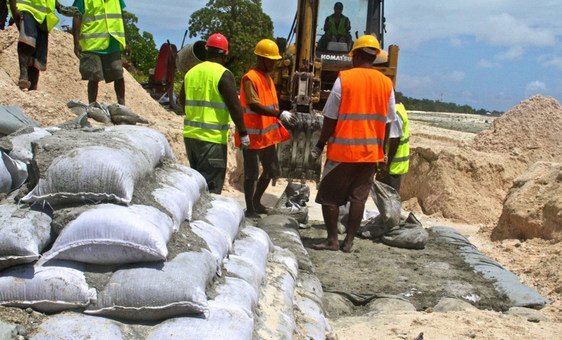
Lauren Day/World Bank | Building seawalls along the coastline in Tarawa, Kiribati, to to protect against high tides or tsunamis.
What is happening to these countries “is a sign of what is in store for the rest of us”, he warned. “People all over the world are starting to feel the impacts of the climate emergency – and these will only worsen”. 
The UN chief recalled meeting young children who “are already fearful for their future and are relying on my generation to secure it”.  
“As Secretary-General of the UN, I have many battles”, he said. “But as a grandfather, the struggle against climate change is the fight of my life”. 
Noting that “we are not winning”, Mr. Guterres urged that political will must be fund “to take transformative measures”.  
“We must acknowledge the moral authority of the Pacific nations, frontrunners in the race against the climate emergency”, he stated
“And we must find sustainable solutions, invest in renewable energies and increase resilience and adaptation”. 

Achieving ‘essential’ goals 

The clearly laid-out goals of the scientific community to achieve carbon neutrality by 2050 and limit global warming to 1.5C by the end of the century, are “essential”, according to the UN chief. 
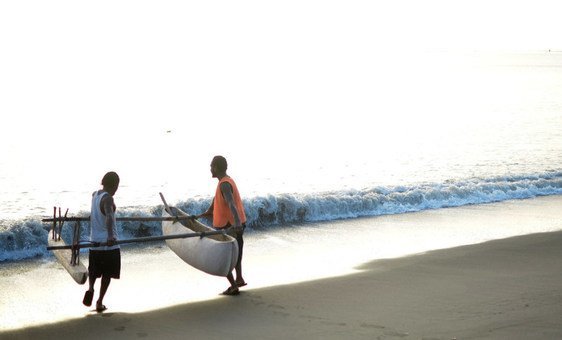
Thomas Michael Perry/World Bank | Fishermen on Vanuatu's Malekula Island launch their outrigger canoe.
As the global community pursues those goals, he restated his message to Governments to “shift taxes from salaries to carbon”, saying “we should tax pollution, not people”. 
He also urged them to “stop subsidizing fossil fuels” because “taxpayers’ money should not be used to boost hurricanes, spread drought and heat waves, and melt glaciers”. 
“Stop building new coal plants by 2020”, he continued. “We need a green economy, not a grey one”. 
He stressed that we have the tools to tackle the climate crisis, to “save lives and property, breathe less polluted air, access cleaner water and protect biodiversity”.  
“Climate action could also yield a direct economic gain of $26 trillion, compared to business as usual, through to 2030, making it a cost-effective option” argued the UN chief. 
Turning to his climate action summit, Mr. Guterres flagged that he is asking world leaders to come “not just with speeches” but with “plans to transform energy, mobility, industry and agriculture”, and to implement their commitments to climate financing, “not out of generosity but enlightened self-interest”. 
“Urgent climate action is a choice we can – and must – make”, concluded the Secretary-General. “As the people of Tuvalu know all too well: Saving them will save us all”. 


♦ Receive daily updates directly in your inbox - Subscribe here to a topic.
♦ Download the UN News app for your iOS or Android devices.

NEWS TRACKER: PAST STORIES ON THIS ISSUE

UN chief calls for ‘enlightened self-interest’ from world leaders to save ‘the whole planet’ from climate change 

Concluding a week-long visit to the South Pacific, United Nations Secretary-General António Guterres called on the world’s decision-makers to make “enlightened” choices on climate action because “the whole planet” is at stake. 

Stop Tuvalu and ‘the world from sinking’ UN chief tells island nation facing existential threat from rising seas

Tuvalu “faces an existential threat from sea-level rise”, the United Nations chief said during his visit to the Pacific island nation on Friday whose highest point is less than five metres above the waves.