Monday, 28 September 2020

CAMA! STRATEGIC ANALYSIS OF AN ISLAMIC AGENDA!


CAMA! STRATEGIC ANALYSIS OF AN ISLAMIC AGENDA!

Uploading: 1339349 of 1339349 bytes uploaded.

  (Part 2A)

RESTRUCTURE BEFORE REFORMS

...CAMA THE CHURCH AND BUHARI'S LOPSIDED NIGERIA


(By Amaso Jack)


(The preview, published earlier, is presented in light blue for those who read it before and require additional information.)


(For Strategic Politics with Amaso Jack,

 my stolen but legally protected facebook page. Friday, September 25, 2020)


“To those of you who think the Government regulates Churches in the UK and as such, the CAMA Bill in Nigeria should stand.


“I am a Pastor in the UK. This means I can speak on this issue.


“As a Church in the UK, you are seen as a charity. The UK government gives grants to the Church. For example, the government can give you £50k (N30 million Naira) at the end of the year based on how much your Church performed that year.” Pastor Woruka said"


Pastor Dennis Woruka Jnr,

The General Overseer of Fountain of Souls Ministries International,


https://thenigerialawyer.com/cama-2020-uk-govt-gives-about-n30-million-grant-to-churches-annually-stop-comparing-uk-with-nigeria-pastor-dennis-woruka/


BIRD'S EYE VIEW  AND PREVIEW


Bird's eye view'

When provocative laws are pursued in  the face of injustice, trouble is inevitable! That is what Ironsi did on May 24, 1966, only for violence to erupt five days later on the 29th, this is what Buhari is doing in 2020 with CAMA, Water Resources Bill and others, Buhari is luckier, the docile nature of the South is working in his favour…..but for how long?


These laws are complementary tactical components of the same strategic intent, but that should not foreclose nor divert attention from some pastors who are taking undue advantage of their flock for personal gain, nor is the action of such pastors a justification for a regime with a clear Islamic tilt (a fact established in the first part) attempt to tamper with the leadership and ownership structure of the church, by the provocative sections of CAMA…. threatening the very roots of the Christian faith in Nigeria, nor should the quest to regulate by government, trample of the fundamental human right of association, of these pastors, considering the fact that unlike, the United Kingdom, where churches get subversions for social work from the government, for which monitoring is required, no such subversions are received in Nigeria.


PREVIEW:


Buhari was the transport officer in charge of Ironsi's staff car, and those of other senior officers like Maimalari, in 1966.


Ifreke Inyang, in his December 23, 2012 account, published in Daily Post, quotes Buhari as saying:


"I was first in Lagos, as Transport Officer. That was where I was till the January coup."


https://dailypost.ng/2012/12/23/i-forgiven-obasanjo-i-wont-forget-babangida-me-buhari/


He didn't learn from the GOC Nigerian Army; Ironsi, just the way Ironsi, who was ADC to Sir John Macpherson, Nigeria's Governor-General between 1948 and 1955, didn't learn from his boss. It is not clear to this writer how long he served as aide-de-camp to John Macpherson, but in 1956, he was equerry to Queen Elizabeth II when she visited Nigeria, a responsibility for which Ironsi was specially trained.


Until Buhari's CAMA 2020, is understood within the historical context of Ironsi's decree 34 of 1966, and his deceptive decision to downgrade clear fulani territorial expansionism to farmer header crisis, is understood as a reminder of Ironsi's foot dragging of the trial of the January 1966 coup plotters (that eventually led to the civil war) but his swift justice to Adaka Boro, are all understood, in the context of history, the very important historical basis of CAMA, as a seed of a religious war in the mould of Decree 34 of 1966, will not be understood.


Part 2 consists of


1 Buhari's dangerous reproduction of Ironsi's blunder!


A coup took place in January 1966, planned by mostly Igbo Officers, rather than Ironsi bringing the killers to swift Justice, like he did to Adaka Boro and his Niger Delta separatist, of February 1966 he chose to foot drag; promulgating the highly provocative Decree 34 of 1966.


Buhari has chosen Ironsi's path. A globally respected organization called Fulani expansionism, terrorism, rather then bring them to justice, like Ironsi, who went for Niger Delta separatist, Buhari has chosen to go for IBOP separatist!


Like Ironsi, he has undertaken the burial of rites of Nigeria with a series of laws like CAMA and the Water Resources Bill, that seek to make Nigeria a Unitary state.  At this critical moment when the clamour to return the country to the path of TRUE FEDERALISM, is very loud, Buhari by these laws is taking us back to Ironsi's disruption of Federalism!


 Like Ironsi did with Decree 34, he is doing same with CAMA, and his infamous Water Resources Bill, the rubber stamp 9th National assembly under Ahmed Ibrahim Lawan, who in the 8th assembly under Saraki, was a major supporter of the Water Resources Bill, has by his position of Senate president, become an infamous accomplice in Buhari's path to war, by supporting the dangerous attempt at  controlling the management STRUCTURE of the CHURCH, just the way Ironsi administratively controlled the entire country; a move that was a catalyst of the civil war.  Buhari by his lopsided Islamic FULAN/KANURI hegemony, is treading a provocative path of a religious war. While this is on, some Pastors are taking financial advantage of their members, will a responsible government sit by and watch this?


 But what moral right of neutrality, has a lopsided government with an ethnoreligious tilt, got to intervene in a rival religion?


Does a government with an ethnoreligious tilt have the MORAL RIGHT of INTERVENTION?


Finally, the historical questions of the 1966 coup is laid to rest by no other person than General Ibrahim Babangida, the most important Individual on the subject of coups, the issues he put to rest was…. WAS THE 1966 COUP AN IGBO COUP?


BUHARI IN THE SHADOWS OF IRONSI


Buhari has chosen to go the path of Ironsi, by advancing dangerous laws like CAMA,  while turning a blind eye to Injustice, like Ironsi (even though Ironsi insisted justice will be done) but he doesn't want Ironsi's result of a civil war! Ironsi didn't bring the perpetrators of the January 15, 1966 coup (most of whom like him were Igbo) to justice. For an offence in January, trial was fixed for August, then shifted to October….Justice delayed had become justice denied, he didn't stop there, he but went about his provocative Decree 34 of 1966, this is what Buhari is replaying with the Fulani herdsmen, whose expansionism, he down plays as farmer/herder crisis, while pushing provocative laws like CAMA through!


PROFESSOR BANJI AKINTOYE:


"Fulani already prosecuting their war against Nigerians —Prof Banji Akintoye" https://www.google.com/amp/s/tribuneonlineng.com/fulani-already-prosecuting-their-war-against-nigerians-prof-banji-akintoye/amp/


His pidegree


"Professor Banji Akintoye is an eminent ….. African historian with famous works in the history of the Yoruba people of south-western Nigeria in West Africa….. (with) …...and a Ph.D. in African History at the University of Ibadan"

https://www.obafemiawolowofoundation.org/30th_anniversary_akintoye_profile.php


PROFESSOR UZODINMA NWALA


"Fulani have taken over Nigeria’s affairs – Prof Nwala, ADF president"


https://www.google.com/amp/s/punchng.com/fulani-have-taken-over-nigerias-affairs-prof-nwala-adf-president/amp/


ONE EVIL SOUTHERN NIGHT…..

In one evil Southern night, the North lost all their men of substance!


On the political side,


1 Alhaji Sir Abubakar Tafawa Balewa, the Prime Minister was brutally murdered.


2 Alhaji Sir Ahmadu Bello KBE, M.H.A., Sardauna of Sokoto, whose real name was Ahmadu Rabah, was brutally murdered.


On the military side, the top four most senior officers from the North, were brutally murdered


1 Brig. Zakariya Maimalari

2 Col. Kur Mohammed

3 Lt. Col. Abogo Largema

4 Lt. Col. James Pam


While it is true Ironsi was not a part of the coup, his subsequent actions put doubts around him, though he was indeed a target but escaped, and went on to set up a board of inquiry to investigate the rebellion of 1966,


MEMBERS OF THE INVESTIGATING BOARD OF INQUIRY


Military historian Max Siollun on the 93rd page of his 2009 Algora published book he titled,


"Oil, Politics and Violence Nigeria's Military Coup Culture 1966-1976)"


 identified members of the board of inquiry as


     1 Lt. Col Gowon,

     2 M. D. Yusuf,

     3 Assistant Commissioner of Police Isa Dejo ( Special Branch police officers) and

      4 British police officers.

     Captain Baba Usman


Siollun then added on the 94th page:


 "According to the Eastern Region

Lt-Colonel Gowon was in charge of producing the white paper but procrastinated on it, and every time he was asked in SMC meetings to report on its progress, replied that he needed more time…...

"Captain Baba Usman (who was closely Involved in the investigation) subsequently claimed that the Special Branch report was ready at the end of March 1966."


Ironsi delay as Supreme Commander in bringing the January coup plotters to justice in addition to the Decree 34 of 24 May 1966 led to five vital bloody repercussions:


1 The May 29 1966, attack on Igbos in the North

2 The Counter coup of July

3 More pogroms against Igbos

4 The secession

5 The above were the remote causes of the civil war, but the immediate cause of the war was Gowon, who reneged on the terms of Aburi accord.


The civil war was caused by the only two Supreme Commanders ever to rule Nigeria, Ironsi and Gowon!


IMPLOSION!


The action of some Igbo traders in the North was the catalyst that helped  to provoke the planned pogroms in the North, against them.


On the 200th page of his 1971 Methuen & Co LTD,book:


 "Studies in African History"

 book he titled

"The Nigerian Army 1956-1966",


 N. J. Miners, who was a teacher in King's College Lagos, for the nine year period between 1957-1966 wrote:


"Quite apart from the May Decrees,there were reasons enough for discontent in the North. In the first place, there was the provocative behavior of many Ibos. After the murder of the Sardauna,Ibos in the North held parties to celebrate their victory, displayed photographs of the Sardauna and his 'conqueror', Major Nzeogwu, in the markets and gave great offence by continually playing a particular gramophone


(page 201)


record which simulated the sound of machine gun fire. Their boasting and derogatory remarks about the Northerners are perhaps, understandable, now that they had achieved relief from years of threats and increasing economic discrimination.

But it did not convince the indigenous Northerners of the genuineness of the Military Government's good intentions."


This action by Igbo traders in the North, helped to fuel the anger and hate that propelled the organized pogroms against them.


BUHARI LIKE IRONSI: DAWN OF POWER DAWN OF HARDSHIP


N. J. Miners, added on this from page 201


"Secondly, the early months of the Ironsi regime coincided with sharp increases in the price of foodstuffs"


By a strange coincidence, when Ironsi came to power, there was an increase in  the prices of foodstuffs, just as the Naira rapidly lost value when Buhari came to power in 2015 and has gone from bad to worse under covid-19.


Damilare Famuyiwa, in his March 1, 2019 account published in  nairametrics he titled:


"Next Level: Exchange rate under Buhari by 2023"


…..provided the following information.


"The naira has been weakened against the U.S. dollar since June 2015 when the Central Bank of Nigeria (CBN) scrapped the currency peg that had kept it at an artificially-high value of around N198 per $1.


Following the scrapping of the peg, naira lost over 40% of its value against the US dollar. While the Central Bank had pledged to move to a free-floating exchange regime, it intervened in the foreign exchange market after the devaluation to keep the naira within a narrow range of N282 to N285 per USD"


https://nairametrics.com/2019/03/01/next-level-exchange-rate-under-buhari-by-2023/


JANUARY 1966 COUP D'ÉTAT, THE ELIMINATION OF THE CREAM OF THE NORTH….THE BASIS OF NORTHERN ANGER.


Military historian Max Siollun, on 97th page of his very first book titled:


 "Oil, Politics and Violence"


….a book  that took him over ten years of research, published by Algora books in 2009, wrote:


"The suppressed rage of Northern NCOs had been a ticking time bomb since January. By mid 1966, there was an unwritten consensus among Northern soldiers that there would be a 'July rematch' with their Igbo colleagues. This 'rematch' is today referred to as the 'counter-coup.' With their overwhelming numerical presence in the infantry (approximately 70-80% of the army's infantrymen were Northerners), it was clear that a revenge coup by Northern soldiers would have drastic consequences. Northern soldiers decided to take the law into their own hands. Their long list of grievances was growing daily:


     •The murder of their military and civilian leaders.


     •The January Majors had still not been tried and were being paid while in detention.


     •The Unification Decree.


     •Rumours of a further Igbo coup to eliminate all remaining Northern soldiers.


     •The promotion of several Igbo Majors to Lt-Colonel.


     •Aguiyi-Ironsi allegedly surrounding himself with other Igbos.


     •Aguiyi-Ironsi's plan to rotate the military governors.


     •The planned swap of 1st and 4th battalions.


A platoon commanders course in Kaduna brought several junior Northern officers together (including Lieutenants Sani Abacha, Abdullahi Shelleng, Haladu Hannaniya, Muhammedu Jega, Yakubu Dambo and Wali) they typed and sent an anonymous letter to the most senior Northern officer Lt-Colonel Gowon. The letter warned that unless senior Northern officers took action to avenge the murders of January within a certain deadline, the junior officers would take the law into their own hands. It is not known whether Gowon communicated the contents of this letter to his colleagues in the SMC"


Continues

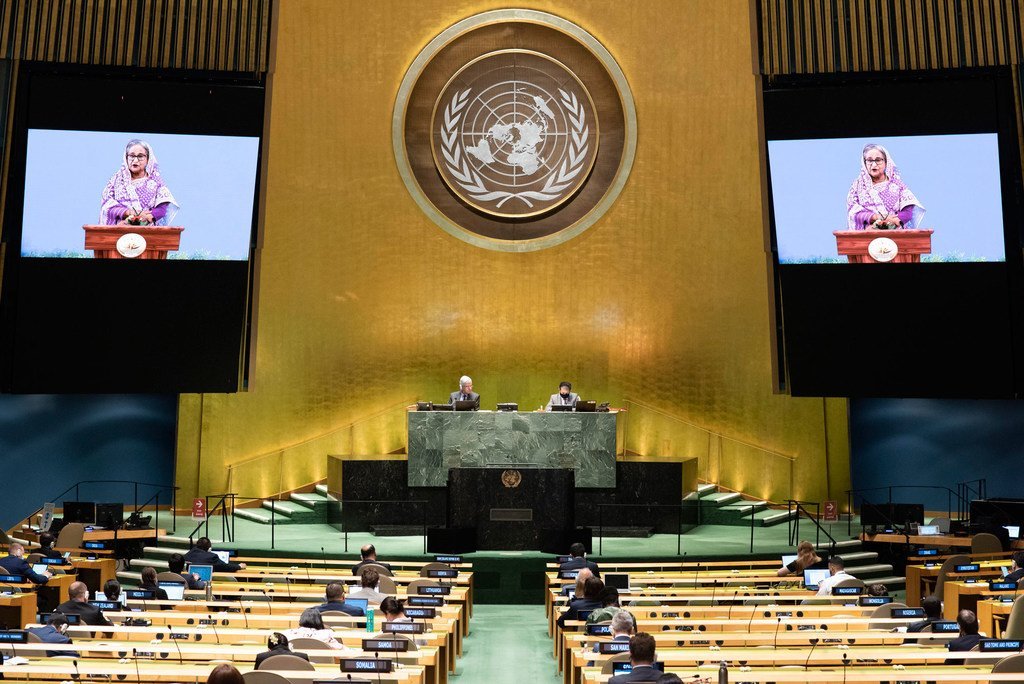
Bangladesh urges greater international action on Rohingya status


Bangladesh urges greater international action on Rohingya status


UN Photo/Evan Schneider
Prime Minister Sheikh Hasina (on screen) of Bangladesh addresses the general debate of the General Assembly’s seventy-fifth session.
26 September 2020

The Prime Minister of Bangladesh has called for stronger international action to help Rohingya refugees in the country to return to neighbouring Myanmar. 

Bangladesh is hosting more than one million Rohingya, a mainly Muslim minority community who are stateless, most of whom fled following a wave of violence in Myanmar’s Rakhine state in 2017. 

“More than three years have elapsed. Regrettably, not a single Rohingya could be repatriated. The problem was created by Myanmar, and its solution must be found in Myanmar. I request the international community to play a more effective role for a solution to the crisis,” Prime Minister Sheikh Hasina said in a pre-recorded speech to the UN General Assembly on Saturday. 

The annual gathering of Heads of State and Government in the iconic General Assembly Hall is being held virtually this year due to the COVID-19 pandemic. 

Stimulus packages and safety nets 

Like many of her counterparts, Prime Minister Hasina outlined steps her Government has taken to address the crisis and mitigate its impacts. 

Although COVID-19 has impeded economic progress in Bangladesh, she said the authorities implemented initiatives which prioritized both lives and livelihoods, such as introducing some $13.25 billion in stimulus packages for industries, and expanding social safety nets. 

“We have readily arranged food and other assistance for people who are rendered jobless due to COVID-19. This arrangement has benefitted nearly 10 million families. We have provided scholarships to four million students. We have also given cash incentives to five million people, including farmers, workers and labourers affected by the pandemic,” she said. 

“To ensure healthcare of the common people, we are providing 30 types of medicines free of cost through 18,000 community clinics and union health centres," she continued, noting that overall, the pandemic's impact has been minimal due to the various interventions.  

Feeding the nation 

Meanwhile, food production has been the top priority during the pandemic, she said. Special arrangements have been made to keep industries up and running, among other measures, all in compliance with health guidelines. 

“Consequently, our health sector and economy are still comparatively at a better shape. Despite the COVID-induced stagnation in global industrial outputs, our GDP has registered a growth rate of 5.24 per cent, which is expected to be seven per cent in the next fiscal year.” 

A vaccine for all 

Prime Minister Hasina said COVID-19 has been a stark reminder “that our fates are interconnected and that no one is secured.”  

She expressed hope that any vaccine against the disease will be readily available to anyone, anywhere who needs it. Bangladesh could also contribute to the process, she added. 

“It is imperative to treat the vaccine as a ‘global public good.’  We need to ensure the timely availability of this vaccine to all countries at the same time,” she told world leaders. 

“If we are provided with the technical know-how and patents, the pharmaceutical industry of Bangladesh has the capacity to go for vaccine production in mass-scale.” 

Pope on collaboration between Italian security personnel and Holy See


Pope on collaboration between Italian security personnel and Holy See

Pope Francis commends the Inspectorate of Public Security at the Vatican on its 75th anniversary on Monday, recounting its history of service to the Holy See and Italy.

By Vatican News English Service

Pope Francis, on Monday, expressed his "affectionate" greetings to a group gathered in audience representing the Inspectorate of Public Security at the Vatican on the occasion of the 75th anniversary of its foundation. Among those present were the Interior Minister, Luciana Lamorgese and the Chief of Police, Franco Gabrielli.

He noted that this anniversary celebration of the founding of the Inspectorate is an occasion to thank the Lord for the work of the many men and women of the Italian Police, who for 75 years have competently and passionately kept the bond alive between the Holy See and Italy.

History of service

Pope Francis recalled that the Inspectorate’s mission finds its origins in the Lateran Pacts of 1929. In addition to creating the Vatican City State, this accord also provided for particular arrangements for St. Peter’s Square, with free access for pilgrims and tourists under the supervision of the Italian authorities. Subsequently, in March 1945, the "St. Peter’s Special Office of Public Security" was created.  

“From the day of the establishment of that office…a path has unfolded as a sign of the fruitful collaboration between Italy and the Holy See, and between the Inspectorate and the Vatican bodies responsible for public order and security of the Pope,” he said.

The Pope gave the example of the nine-month occupation of Rome by German troops from September 1943 which hindered the faithful from visiting St. Peter's Basilica to pray. He explained that since Rome's liberation on 4 June 1944 and the return of pilgrims to the Basilica, the new office of the State Police at the Vatican has been able to respond to the new needs and has provided this important service of security to both Italy and the Holy See.

Gratitude

Pope Francis noted that even though the institution has taken on other names till its present one, and national/international scenarios, as well as security arrangements have changed, the spirit of the men and women of the Inspectorate has remained the same.

He expressed his gratitude to the officials for their service characterized by diligence, professionalism and sacrifice, particularly exhibited in their patience in dealing with people from diverse backgrounds and cultures. 

He further thanked them for their commitment in accompanying him during this travels within Rome and to other dioceses in Italy, acknowledging that is "a difficult job" ensuring that the Pope's travels do not lose their specific character of "encounter with the People of God."

Call to highest values

Pope Francis encouraged the security personnel to see their work as a constant reminder of the highest values - the human and spiritual values that need to be accepted and witnessed daily.

He also hoped that their hard work, accomplished through sacrifice and risk will be driven by a Christian faith which is the “most precious spiritual treasure” entrusted to them by their families which they are called to pass on to their children.

“May the Vatican Inspectorate of Public Security continue to operate according to its distinguished history, knowing how to draw new and abundant fruits from it,” Pope Francis said.

Concluding, the Pope prayed through the intercession of St. Michael the Archangel – the Inspectorat


AGEGE BRIDGE AT ADVANCE STAGE OF COMPLETION BY ABDULMUMINI ADEKU ,LAGOS,NIGERIA.


AGEGE BRIDGE AT ADVANCE STAGE OF  COMPLETION

BY ABDULMUMINI ADEKU ,LAGOS,NIGERIA..

HIGHLIGHTS

1]Agege Bridge construction remains in full force as despite the heavy rains construction activities continues as at press time.

2]at least four Lebanese Engineers spotted at construction site

3]Project is a symbol of Nigerian -Lebanese Engineering ingenuity

4]Several artisans spotted joining rods and wires to be used for the drains as at 18th of September,2020..

5]Several blocks of  constructed drainage canals spotted at construction sites

6]Flood lights lit at night when construction work goes into the night

7]Hitech Engineering Limited is behind the project

8]Major architectural landmark in Lagos  after the Third Mainland Bridge ,Eko ,Carter Bridge,Lekki-Ikoyi Bridges

9]At least 15 minutes walk on the bridge by foot

10]Puddles of water ponds at foot of bridge towards abattoir..

11]Barbed wire fence created by firm to keep pedestrians away towards Capitol Road end now have holes created by Pedestrians

12]This reporter saw cement been mixed for work as at press time ,18th of September,2020..

13]Bridge now 51-55 percent complete as work continues  

PICTURE CREDIT:PAEDIA SHOTS 


List of nomadic peoples


List of nomadic peoples

This is a list of nomadic people arranged by economic specialization and region.

Nomadic people are communities who move from one place to another, rather than settling permanently in one location. Many cultures have traditionally been nomadic, but nomadic behavior is increasingly rare in industrialized countries. Nomadic cultures are listed in three categories of economic specialization: hunter-gatherers, pastoral nomads, and "peripatetic nomads".

Contents

·         1Hunter-gatherers

o    1.1Africa

o    1.2Americas

o    1.3Asia

o    1.4Oceania

o    1.5Europe

·         2Pastoralists

o    2.1Africa

o    2.2Americas

o    2.3Asia

o    2.4Europe

o    2.5Middle East

o    2.6Popular Misconceptions

·         3Peripatetic

o    3.1India

o    3.2Pakistan

o    3.3Turkey

o    3.4Afghanistan

o    3.5Middle East

o    3.6Europe

o    3.7North America

·         4References

Hunter-gatherers[edit]

Main article: Hunter-gatherer

See also: Uncontacted peoples

Nomadic hunting and gathering, following seasonally available wild plants and game, is the oldest human method of subsistence.

Africa[edit]

·         Hadza people

·         Pygmies

o    Twa people

o    Mbuti

·         San people

Americas[edit]

·         Abenaki

·         Aché

·         Alaskan Athabaskans

·         Aleut

·         Alutiiq

·         Apache

·         Beothuk

·         Cheyenne

·         Chichimeca

·         Chiquillanes

·         Chitimacha

·         Chumash

·         Chono

·         Clovis culture

·         Cody complex

·         Comanches

·         Crow

·         Dalton Tradition

·         Dene

·         Dorset culture

·         Eyak

·         Folsom culture

·         Greenlandic Inuit

·         Guarani

·         Haida

·         Hell Gap complex

·         Indigenous peoples of California

·         Ingalik

·         Innu

·         Inuit

·         Iñupiat

·         Karankawa

·         Kawésqar

·         Koyukon

·         Lakota

·         Makah

·         Maritime Archaic

·         Menominee

·         Navajo (until the sixteenth century with the introduction of sheep, and the adoption of agriculture from the Puebloans)

·         Nez Perce

·         Norton tradition

·         Nukak-Makú

·         Ojibwe

·         Oshara Tradition

·         Oxbow complex

·         Paiute

·         Paleo-Arctic Tradition

·         Pirahã

·         Plains Indians

·         Plano culture

·         Puelche

·         Red Ocher people

·         Red Paint People

·         Sioux (from around the 17th century onwards, they were previously a farming people who lived in the Ohio RiverValley

·         Tehuelche

·         Thule people

·         Tlingit

·         Utes

·         Yaghan

·         Yahi

·         Yanomami

·         Yupik

Asia[edit]

·         Adivasi

·         Aeta

·         Ainu

·         Altai

·         Andamanese

o    Great Andamanese

o    Jarawa

o    Lodha

o    Onge

o    Sabar

o    Sentinelese

o    Shompen

·         Ati

·         Batek

·         Chukchi

·         Denisova hominine

·         Dolgans

·         Ket

·         Nganasan

·         Nicobarese

·         Papuans

·         Penan

·         Raute

·         Selkup

·         Semang

·         Siberian Yupik

·         Yakuts

·         Homo erectus (Paleolithic era)

Oceania[edit]

·         Most Indigenous Australians prior to Western contact

·         

o    Spinifex People

o    Tasmanian Aborigines

o    Tiwi

Europe[edit]

·         Cro-Magnon

o    Aurignacian

o    Gravettian

o    Magdalenian

o    Hamburg

o    Solutrean

·         Neanderthals (during the Paleolithic)

·         Sami (formerly, up until the fifteenth century)

Pastoralists[edit]

Main articles: Pastoralism and Transhumance

Pastoralists raise herds, driving them or moving with them, in patterns that normally avoid depleting pastures beyond their ability to recover. The pastoralists are sedentary, remaining within a local area, but moving between permanent spring, summer, autumn and winter (or dry and wet season) pastures for their livestock.

Africa[edit]

·         Ababdeh

·         Afars

·         Beja

·         Berbers

·         Borana Oromo

Dinka [Jieng]

·         Fulanis

·         Gabra

·         Karamojong

·         Maasai (originally, now settled or semi-nomadic)

·         Mrazig of Tunisia

·         Nuer

·         Pokot

·         Rendille

·         Sahrawis

·         Samburu

·         Somalis

·         Tuaregs

·         Toubou

·         Trekboers

·         Turkana

Americas[edit]

·         Nukak

·         Navajo

Asia[edit]

·         Some Komi

·         Ahir

·         Altay people

·         Baloch

·         Balti

·         Banjara

·         Chukchi

·         Dhangar

·         Enets people

·         Evenk people

·         Evens

·         Gaddis

·         Gaderia

·         Gavli

·         Gujjar only in Gilgit BaltistanKashmir, and parts of Khyber Pakhtunkhwa

·         Gujar

·         Hmong

·         Huns

·         Jat

·         Khanty people

·         Kuchi

·         Kurumbar

·         Maldhari pastoralist groups of Kutch such as:

·         Mansi people

·         Moken

·         Mongols

·         Nenetses

·         Slavic peoples (ancient, early medieval age)

·         Tarkhans

·         Tibetans (primarily the Changpa at present)

·         Turkic (ancient, medieval age)

·         Turkic (present)

o    Xiongnu

o    Yukaghirs

o    Ahir

o    Bafan

o    Bayad

o    Bharwad

o    Bulgars (briefly, between the conquest of the hypothetical Kingdom of Balhara and the formation of Great Bulgaria)

o    Charan

o    Crimean Tatars (certain groups)

o    Cumans (up until the formation of the country Wallachia/Basarabia)

o    Halaypotra

o    Hingora

o    Jat

o    Karakalpaks

o    Kathi

o    Kazakhs

o    Ker

o    Khakas

o    Khant

o    Khazars

o    Kipchaks

o    Kyrgyz

o    Me

o    Meta Qureshi

o    Mutwa

o    Node

o    Nogais

o    Pancholi

o    Avars

o    Paratharia

o    Pechenegs

o    Qashqai

o    Rabari

o    Raysipotra

o    Royma

o    Samma

o    Sandhai Muslims

o    Sanghar

o    Seljuks (during the Middle Ages anyway)

o    Shahsevan

o    Soomra

o    Sorathia

o    Theba

o    Turkmens

o    Tuvans

o    Wagher

o    Warya

o    Yörük

o    some northern Yakuts

o    Shors

o    Soyots

o    Telengits

o    Teleuts

o    Tofalar

o    Tozhu Tuvans

o    Tsaatan

Europe[edit]

·         Bashkirs

·         Germanic peoples (ancient, early medieval age)

·         Magyars (ancient, early medieval age)

·         Sarakatsani

·         Serbian people (to late medieval period)

·         Slavic peoples (ancient, early medieval age)

·         Some reindeer-herding Sami communities

·         Vaqueiros de alzada

Middle East[edit]

·         In Iran[citation needed]

o    َAshayer

§  Qashqaie

§  Bakhtiari

§  Khamseh

§  Baloch

·         In Afghanistan

o    Kuchis (Kochai)[1]

o    Hephthalites

o    Hunas

o    Kouchi of Afghanistan

·         In Iraq

o    Bedouin

o    Alans

o    Dahae

o    Parni

o    Parthians

o    Sarmatians

·         Scythians

·         Mitanni

·         Turkmen

Popular Misconceptions[edit]

The Manchus are mistaken by some as nomadic people[2] when in fact they were not nomads,[3][4] but instead were a sedentary agricultural people who lived in fixed villages, farmed crops, practiced hunting and mounted archery.

The Sushen used flint headed wooden arrows, farmed, hunted, and fished, and lived in caves and trees.[5] The cognates Sushen or Jichen (稷真) again appear in the Shan Hai Jing and Book of Wei during the dynastic era referring to Tungusic Mohe tribes of the far northeast.[6] The Mohe enjoyed eating pork, practiced pig farming extensively, and were mainly sedentary,[7] and also used both pig and dog skins for coats. They were predominantly farmers and grew soybean, wheat, millet, and rice, in addition to engaging in hunting.[8]

The Jurchens were sedentary,[9] settled farmers with advanced agriculture. They farmed grain and millet as their cereal crops, grew flax, and raised oxen, pigs, sheep, and horses.[10] Their farming way of life was very different from the pastoral nomadism of the Mongols and the Khitan on the steppes.[11][12] "At the most", the Jurchen could only be described as "semi-nomadic" while the majority of them were sedentary.

The Manchu way of life (economy) was described as agricultural, farming crops and raising animals on farms.[13] Manchus practiced Slash-and-burn agriculture in the areas north of Shenyang.[14] The Haixi Jurchens were "semi-agricultural, the Jianzhou Jurchens and Maolian (毛怜) Jurchens were sedentary, while hunting and fishing was the way of life of the "Wild Jurchens".[15] Han Chinese society resembled that of the sedentary Jianzhou and Maolian, who were farmers.[16] Hunting, archery on horseback, horsemanship, livestock raising, and sedentary agriculture were all practiced by the Jianzhou Jurchens as part of their culture.[17] In spite of the fact that the Manchus practiced archery on horse back and equestrianism, the Manchu's immediate progenitors practiced sedentary agriculture.[18] Although the Manchus also partook in hunting, they were sedentary.[19] Their primary mode of production was farming while they lived in villages, forts, and towns surrounded by walls. Farming was practiced by their Jurchen Jin predecessors.[20][21]

建州毛怜则渤海大氏遗孽,乐住种,善缉纺,饮食服用,皆如华人,自长白山迤南,可拊而治也。"The (people of) Chien-chou and Mao-lin [YLSL always reads Mao-lien] are the descendants of the family Ta of Po-hai. They love to be sedentary and sow, and they are skilled in spinning and weaving. As for food, clothing and utensils, they are the same as (those used by) the Chinese. (Those living) south of the Ch'ang-pai mountain are apt to be soothed and governed."

据魏焕《皇明九边考》卷二《辽东镇边夷考[22] Translation from Sino-J̌ürčed relations during the Yung-Lo period, 1403-1424 by Henry Serruys[23]

For political reasons, the Jurchen leader Nurhaci chose variously to emphasize either differences or similarities in lifestyles with other peoples like the Mongols.[24] Nurhaci said to the Mongols that "The languages of the Chinese and Koreans are different, but their clothing and way of life is the same. It is the same with us Manchus (Jušen) and Mongols. Our languages are different, but our clothing and way of life is the same." Later Nurhaci indicated that the bond with the Mongols was not based in any real shared culture. It was for pragmatic reasons of "mutual opportunism", since Nurhaci said to the Mongols: "You Mongols raise livestock, eat meat and wear pelts. My people till the fields and live on grain. We two are not one country and we have different languages."[25]

Peripatetic[edit]

Peripatetic nomads offer the skills of a craft or trade to the settled populations among whom they travel. They are the most common remaining nomadic peoples in industrialized nations. Most, or all, of the following ethnonyms probably do not correspond to one community; many are locally or regionally used (sometimes as occupational names), others are used only by group members, and still others are used pejoratively only by outsiders. Most peripatetic nomads have traditions that they originate from South Asia. In India there are said to be home of over two hundred such groups.[citation needed] Many peripatetic groups in IranAfghanistan and Turkey still speak dialects of Indo-Aryan, such as the Ghorbati.[26][27] There is also academic scholarship that connects European Romany groups with India.

India[edit]

·         In India:[28]

o    Abdal

o    Aheria

o    Bakho

o    Bangali

o    Bansphor

o    Bazigar

o    Bede

o    Boria

o    Changar

o    Deha

o    Dharhi

o    Dharkar

o    Domba

o    Gandhila

o    Habura

o    Heri

o    Hurkiya

o    Kalabaz

o    Kan

o    Kanjar

o    Karwal

o    Kela

o    Mirasi

o    Mirshikar

o    Nat

o    Pamaria

o    Patharkat

o    Perna

o    Qalandar

o    Sansi

o    Sapera Muslims

o    Sapera

o    Sapuria

Pakistan[edit]

·         In Pakistan:[29]

o    Churigar

o    Dom

o    Kanjar

o    Lori

o    Mirasi

o    Qalandar

Turkey[edit]

·         In Turkey:[30]

o    Abdal of Turkey

o    Arabci

o    Bosha

o    Çingene

o    Gäwändi

o    Ghorbati

o    Qeraçi

o    Susmani

o    Tahtacı

Afghanistan[edit]

·         In Afghanistan:[31]

o    Kuchi (Kochai)[32]

o    Badyanesin

o    Balatumani

o    Chalu

o    Changar

o    Chighalbf

o    Ghalbelbaf

o    Ghorbat (Qurbat)

o    Herati

o    Jalili

o    Jat

o    Juggi

o    Jola

o    Kouli

o    Kuṭaṭa

o    Lawani

o    Luli Mogat

o    Maskurahi

o    Musalli

o    Nausar

o    Pikraj

o    Qawal

o    Sabzaki

o    Sadu

o    Shadibaz (Shadiwan)

o    Sheikh Mohammadi tribe

o    Noristani

o    Siyahpayak

o    Vangawala (Bangṛiwal/Churifrosh)

Middle East[edit]

·         In Iran:

o    Orak

o    Asheq

o    Challi

o    Changi

o    Chareshmal (Krishmal)

o    Dumi

o    Feuj

o    Ghajar

o    Ghorbati (Ghorbat, Gurbat, Qurbati)

o    Gurani

o    Haddad (Ahangar, Hasanpur)

o    Howihar

o    Juki

o    Karachi

o    Kenchli

o    Kowli (Kuli)

o    Luri

o    Luti

o    Mehtar

o    Ojuli

o    Qarbalband

o    Sazandeh

o    Suzmani

o    Tat

o    Toshmal

·         In Iraq:

o    Dom

o    Kowli (Kuli)

o    Zott

·         In Syria:

o    Dom

o    Nawar

Europe[edit]

·         Romani people

o    Sinti

o    Manush

o    Romanichal

o    Romanisæl

o    Iberian Kale (Gitanos)

o    Finnish Kale

o    Welsh Kale

·         Scottish Travellers (Celts)

·         New Age travellers

·         Irish Travellers or Pavees (Celts)

·         Tunodo or Breton Travellers (Celts)

·         Indigenous Norwegian Travellers

·         Yeniche (Celts & Germans)

·         Quinqui

·         Ossetians

North America[edit]

·         Irish Travelers

·         Romani people[33]

·         Carnies

INFORMATION AS SEEN ON GOOGLE